Operate & Finance

Managed monitoring and support plans

Lighting controls drift. Furniture moves, schedules change, sensors fail and overrides become permanent. Our support plans keep the system doing what it was commissioned to do, with response times written into the plan.

ProjectLytbit · Smart lighting & IoT
SheetE-14
Rev26.11
DisciplineManaged Services
DrawnLytbit Engineering
Scale1 : 1
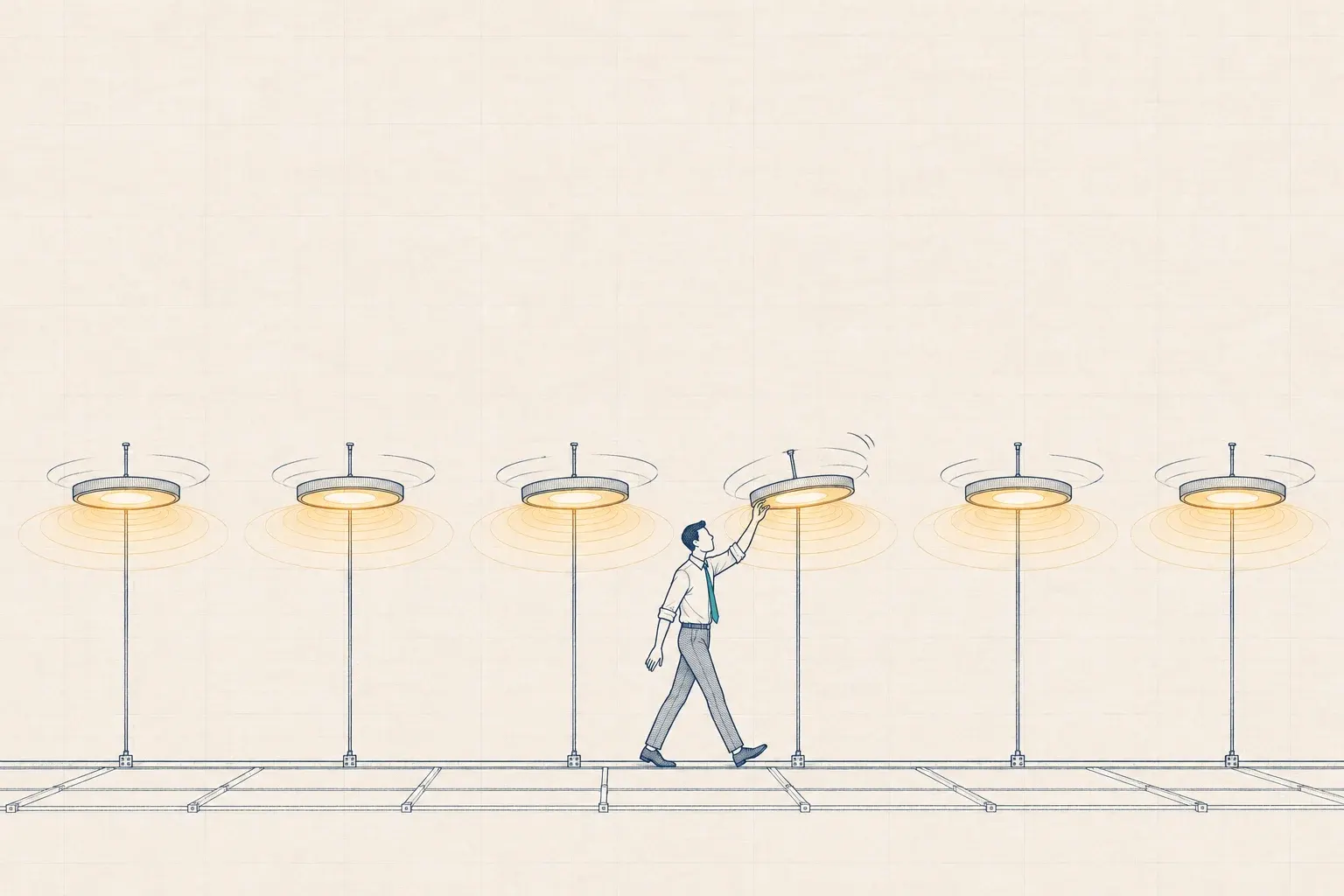
A performer walks along a row of poles, each balancing a spinning round light fixture, and reaches up to steady the one that has started to wobble.
Plate E-14Nothing crashes all at once. It wobbles first, and someone has to be watching.

What changes when we're done

Watch, Tune and Steward support plans for multi-brand lighting controls, defined by scope and response time and monitored on Lytbit Ledger.

  • Faults found by monitoring rather than by occupant complaints
  • Response times written into the plan, not promised in a sales meeting
  • Settings that follow the building as it changes, season by season
  • One support contact for every brand in your ceiling

What's included

Every engagement is scoped to the building, but these are the parts we won't skip.

E-14.01

Remote monitoring

Ledger Watch checks controllers, gateways, schedules and zones continuously, and raises alerts on faults, stuck sensors and lights running in empty spaces.

E-14.02

Defined response times

Each tier sets a response time, measured from alert or ticket to an engineer actively working the problem.

E-14.03

Seasonal re-tuning

On Tune and Steward, scheduled site visits adjust daylight settings, schedules and trim levels as daylight hours, shifts and occupancy change.

E-14.04

Annual re-commissioning

On Steward, a yearly functional test of representative sequences, with an updated configuration report.

E-14.05

Firmware management

On Steward, we track security notices, test updates on the Lytbit Lab bench and schedule rollouts with your IT team.

E-14.06

Manufacturer coordination

We handle warranty claims and escalations with each manufacturer, so you never have to work out which vendor owns a problem.

How it works

The same steps on every project, so you always know what happens next and what you'll receive.

  1. Onboard

    We review the as-built documents and configuration, connect the system to Lytbit Ledger and record how it's set today.

  2. Health check

    An initial review lists existing faults, so the plan starts from a known state instead of inheriting surprises.

  3. Monitor and respond

    Alerts are triaged, ticketed and resolved remotely where possible, with a site visit scheduled when they can't be.

  4. Tune and test

    Seasonal visits and annual re-commissioning follow the calendar for your tier.

  5. Report

    A quarterly report on faults, response times, energy and recommended changes, plus an annual review of the plan itself.

You receive

Deliverables

  • Quarterly report: faults, response times met, energy trends and recommendations
  • Ticket log with timestamps from alert to resolution
  • Updated configuration report after every change
  • Annual re-commissioning test log (Steward)
  • Firmware register with current versions and update history (Steward)

How it's scoped

Annual plan at the tier you choose, scoped by site count, device count and the number of control platforms

  • Tiers are defined by scope and response time. The plan fee follows the size and complexity of your system.
  • Replacement hardware and major changes are quoted separately; warranty claims are handled within the plan.
  • Systems we didn't install begin with an onboarding health check, so the plan starts from a documented state.
  • You can move up or down a tier at renewal.

Good fit if

Who this is for

  • You have networked controls and nobody on staff who knows how to tune them
  • Your system was commissioned once and has drifted since
  • You have several sites or several brands and want one support relationship
  • A financing or incentive arrangement requires ongoing performance reporting

Compare the plans

Every tier includes monitoring on Lytbit Ledger, a quarterly report and manufacturer coordination. Higher tiers add site work, faster response and firmware care.

ScopeWatchTuneSteward
Remote monitoring on Lytbit LedgerIncludedIncludedIncluded
Response timeNext business day8 business hours8 business hours; 4 hours remote for critical faults
Quarterly reportIncludedIncludedIncluded
Manufacturer and warranty coordinationIncludedIncludedIncluded
Seasonal re-tuning visitsNot includedIncludedIncluded
Annual re-commissioningNot includedNot includedIncluded
Firmware managementNot includedNot includedIncluded
Best forStable systems with capable on-site staffDaylight zones, shifts and changing layoutsCritical operations, multi-site portfolios and financed systems

Commissioned is a moment; working is a condition

A lighting control system is never more accurate than on the day it’s commissioned. From then on, it drifts. Someone overrides a schedule for a holiday event and it stays overridden. A tenant fit-out moves a wall, and a sensor now watches a filing cabinet. A gateway loses power in a storm and comes back with an old configuration. None of this is dramatic, so nobody notices until the energy bill rises or occupants start taping over sensors.

The real question is how much ongoing care your system needs, and which tier matches it. The comparison above sets out the scope; here is how we think about each tier.

Watch

Remote monitoring on Lytbit Ledger, next-business-day response and a quarterly report. Watch suits stable systems in buildings with capable facility staff who want a second set of eyes and a clear escalation path. Most issues are resolved remotely, or with your staff on the phone.

Tune

Everything in Watch, plus seasonal re-tuning visits and an 8-business-hour response. The visits matter more than people expect. Daylight settings that were right in June are wrong in December, a second shift added in spring needs new schedules, and a reconfigured floor needs new zones. Tune is our usual recommendation for buildings with daylight zones, multiple shifts or frequent layout changes.

Steward

Everything in Tune, plus 4-hour remote response for critical faults, annual re-commissioning and firmware management. Steward is for buildings where a lighting failure stops work or creates risk, and for systems under financing or performance agreements that require reporting.

Which plan fits which building

Building Plan we’d usually suggest Why
Single office with in-house facility staff Watch Stable use; staff can act on alerts
School or campus Tune Seasonal calendar, summer changes, daylight-heavy classrooms
Manufacturing plant on shifts Tune Schedules follow production, and production changes
Distribution center or cold storage Steward Dark aisles stop work; very high fixture counts
Clinic or outpatient facility Steward Patient-facing spaces with little tolerance for faults
Multi-site retail or branch portfolio Steward One view across sites and consistent firmware

These are starting points. A small building with a critical function can need Steward, and a large, simple warehouse with good staff may do well on Watch.

What firmware management actually involves

Firmware is where support plans usually turn vague, so here is what Steward covers. We keep a register of firmware versions for every controller and gateway, and we track manufacturer security notices. When an update is relevant, we install it on matching hardware in the Lytbit Lab first and check that sequences and integrations still behave. Then we schedule the rollout with your IT team, take a configuration backup beforehand and have a rollback plan ready. We never apply an update simply because it’s available.

Annual re-commissioning, briefly

Once a year under Steward, we rerun the functional test scripts from the original commissioning on a representative sample of spaces, fix what has drifted and issue an updated configuration report. If the system never had test scripts, the first year builds them.

What a plan doesn’t cover

We’d rather say this now than in a dispute later. Plans don’t include replacement hardware outside warranty, new zones or sequences added during a renovation, or expansion to new floors; we quote those separately, from the same documentation. Monitoring also doesn’t replace the periodic testing and inspection of emergency lighting that your fire code and local officials require.

Support for systems we didn’t install

Most buildings we support were designed and installed by someone else, sometimes by a manufacturer that has since left the market. Every plan starts with an onboarding health check and a configuration backup. If the platform itself is nearing end of life, our legacy migration service plans what comes next, and monitoring continues while it happens.
FAQ

Questions we hear often

Still unsure? Write to sales@lytbit.com and a person will answer within one business day.

What counts as a critical fault?

A fault that disrupts operations right now: an occupied area left dark, lights stuck on across a building or site, or a controller or gateway offline that takes zones with it. Each plan lists its fault categories in writing, and we agree any additions with you at onboarding.

What does "response" mean?

An engineer actively working the problem, remotely or with your staff on the line, not an automated acknowledgment. Many faults are fixed remotely. When a site visit is needed, we schedule it and tell you when to expect us.

Do you support systems you didn't install?

Yes, and most of the systems we support will have been installed by someone else. We start with an onboarding health check and a configuration backup, then support the system as if it were our own.

Why re-commission every year?

Because buildings change. Tenants move walls, furniture blocks sensors, and schedules get overridden for one event and never restored. An annual functional test of representative sequences catches drift before occupants or the energy bill do.

Can we start on Watch and move up later?

Yes. Many owners start on Watch, see what the monitoring finds in the first year, and move to Tune or Steward at renewal if the fault log shows they need it.

Inherited a system nobody looks after?

Tell us what's installed and what's bothering you. We'll recommend a tier and start with a health check.