Industries

School and campus lighting controls

Schools rarely need more hardware. They need the controls already in the ceiling to match how teachers teach, how gyms get used at night, and what the calendar actually says. We fix that, then write it down as a district standard.

ProjectLytbit · Smart lighting & IoT
SheetA-04
Rev26.11
DisciplineEducation
DrawnLytbit Engineering
Scale1 : 1
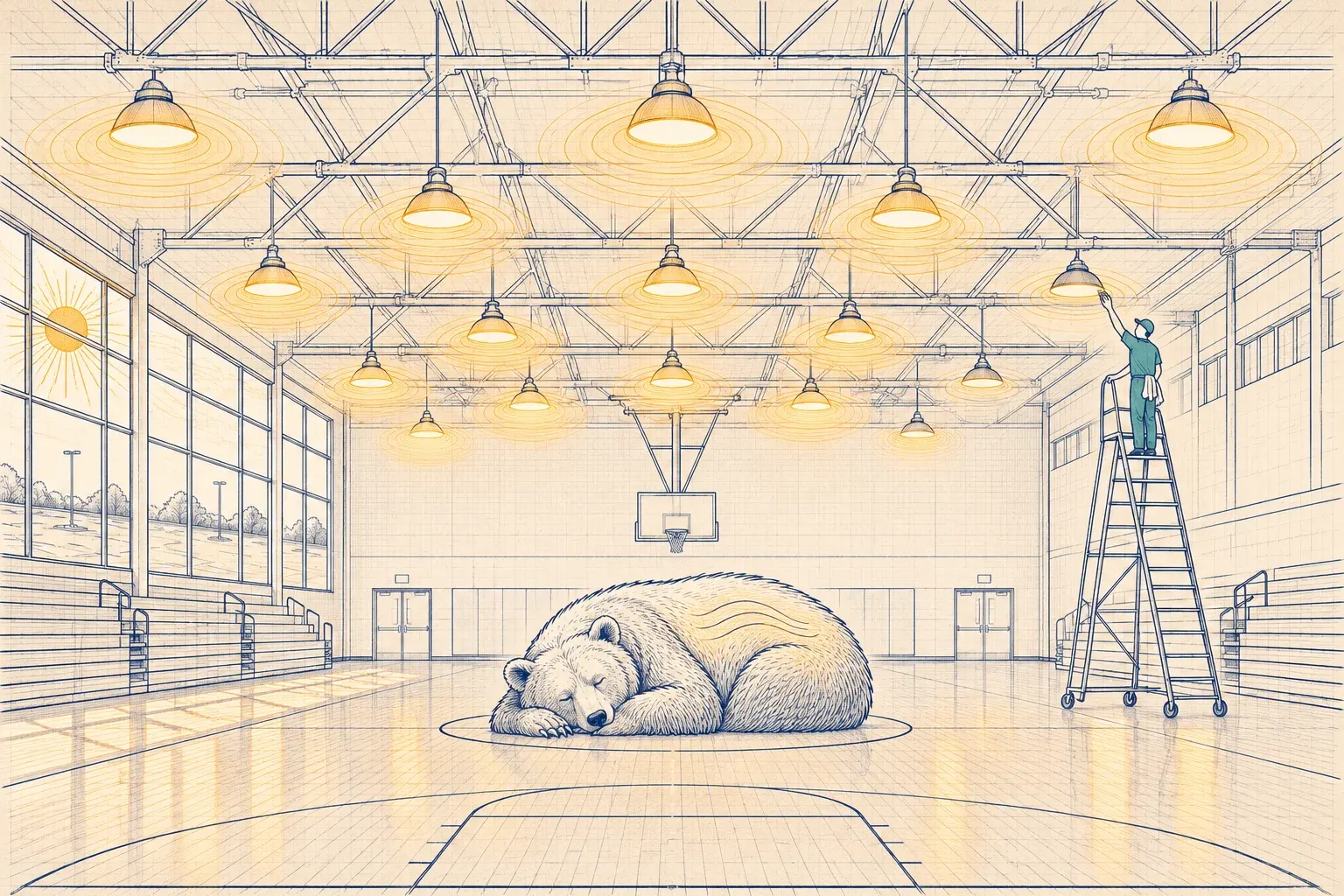
A bear sleeps at center court of an empty gym while high-bay lights blaze overhead; a small custodian on a rolling ladder dims the fixtures one by one.
Plate A-04In July the building should hibernate too, and wake up re-tuned.

What makes these buildings hard

Classroom, gym, and campus controls for K-12 and higher education, with summer schedules, re-commissioning, and district-wide standards.

Condition 01

The calendar is complicated

Instructional days, summer school, testing weeks, board meetings, ball games, and holiday breaks. Controls programmed for a simple weekday schedule run the building at full output through July.

Condition 02

Teachers fight automation

A classroom that turns on by itself, dims during a video, or shuts off during a quiet test teaches staff to tape over sensors.

Condition 03

Systems that drifted

Controls commissioned at construction meet moved bookshelves, new partitions, replaced sensors, and forgotten overrides. Years later, nobody has the configuration records.

Condition 04

Every campus is different

Districts accumulate buildings from different decades on different platforms, which makes training, spare parts, and troubleshooting harder every year.

What we'd do about it

Control strategies that hold up in this building type, in the order we usually apply them.

  1. Teacher-first classrooms

    Manual-on to a partial level, automatic off, a daylight zone by the windows, and a one-button presentation scene for the board or display.

  2. Calendar-driven schedules

    A district calendar loaded once and pushed to every campus, with event overrides that time out on their own.

  3. Summer re-commissioning

    Use the summer window to retest sequences, fix sensor placement, and update configuration records before staff return.

  4. District standards

    One Sequence Book, naming convention, and device list across campuses, written into bid documents so new buildings arrive consistent.

Typical control sequence by space type

Our usual starting points for K-12 and campus buildings, adjusted to each district's calendar and confirmed with staff.

SpaceStrategyTypical setting or behaviorNotes
ClassroomsManual-on, automatic off, daylight zoneOn to a partial level at the switch; off after vacancy; window row dims with daylightPresentation scene dims the front row for displays
CorridorsSchedule plus occupancy dimmingFull output during passing periods; dims between them and after hoursNever below egress minimums
GymnasiumsSchedule, occupancy, and event sceneFull output during school hours; occupancy for practices; event scene times outSensors tested at ceiling height
Cafeterias and multipurpose roomsSchedule plus daylightFollows meal periods; dims with daylight near windowsEvent mode for evening use
Libraries and media centersDaylight plus occupancy by zoneStacks dim when empty; reading areas hold during open hoursLate hours on college campuses
Lecture halls and auditoriumsScenes with AV integrationLecture, presentation, video, and cleaning scenesControls at the lectern and the back of the room
Offices, workrooms, and restroomsVacancy or occupancyOff after a short delayRestroom sensors must see past stall partitions
Parking, bus loops, and fieldsAstronomical schedule plus event overrideOn at dusk for events; dims or turns off after the last eventCoordinate with athletics schedules

New controls, or working controls?

For most districts the question is whether you need new lighting controls or need the ones you already have to work again. More often than not, it’s the second, and it costs far less.

Why school controls drift

Schools are hard on lighting controls. Furniture moves every year. Teachers tape paper over sensors that shut the lights off during tests. Custodians override schedules for events, and nobody undoes the override. Replacement sensors go in with factory default settings. A gym used for basketball, graduation, and a community meeting in the same week has three different lighting needs, and the controls usually know one.

After a few years, the building behaves nothing like the drawings, and nobody has the configuration records to find out why. That is normal, not a failure of the people running the building.

Classrooms: give teachers the switch

Our default classroom sequence is manual-on and automatic off. A teacher turns the lights on, usually to a partial level that is enough for most lessons, and the room turns off after it has been empty for a set time. The row nearest the windows dims with daylight. One presentation button dims the front row for a board or display without plunging the room into darkness.

This sequence is boring, and that is the point. It saves energy because rooms that never get switched on stay off, and it earns teachers’ trust because the room never does anything surprising.

Gyms, cafeterias, and evening use

Large spaces get schedules for the school day and event scenes for everything else. The key is the timeout: an event scene that a coach or facilities staff starts should end on its own, so the gym doesn’t stay lit all night after Friday’s game. We test gym high-bay sensors on our bench at mounting height before they’re specified, because a sensor that can’t see the free-throw line from 30 feet is worse than none.

Summer is the commissioning window

Every school has a few quiet weeks each summer before staff come back. That’s when we re-commission: functional testing of every sequence, sensors moved to where they can see, schedules cleaned up, firmware updated, and configuration records refreshed. It’s also when we load next year’s district calendar, so instructional days, breaks, and summer programs drive the lighting automatically.

If the controls are no longer supported by their manufacturer, summer is also the time to plan a migration. Many districts are living with discontinued platforms, and replacing them in phases over two or three summers keeps budgets manageable.

District standards

A district with ten buildings and six control platforms has six training programs, six spare-parts shelves, and six ways to fail. We help districts write a lighting controls standard: approved device types, a Sequence Book for each space type, naming conventions, and commissioning requirements, written to drop straight into bid documents. New schools and renovations then arrive consistent, and maintenance staff can move between buildings without relearning the system.

For colleges and universities, we apply the same idea inside the campus IT and BMS standards, and coordinate with central IT on network segmentation.

Incentives and code

Public schools in TVA territory can pursue EnergyRight incentives, which require pre-approval before purchase and give additional credit for networked controls. Entergy Mississippi and Mississippi Power customers have their own commercial programs. We prepare the applications, coordinate with your local power company and program staff, and time the paperwork to your board approval and purchasing calendar.

Energy code adoption varies by state and jurisdiction, so we confirm which edition applies with the authority having jurisdiction. Recent editions, including ASHRAE 90.1-2022 and the 2024 IECC, require functional testing of lighting controls in new work and many alterations. Our test logs are written to meet that requirement and to give your maintenance team a script they can rerun.

What we’d do first

Run a one-day sample test in a few representative classrooms, a gym, and a corridor. It tells you whether the problem is settings or hardware. Our commissioning checklist shows what we test.
FAQ

Questions we hear often

Still unsure? Write to sales@lytbit.com and a person will answer within one business day.

Should classroom lights turn on automatically?

We usually recommend manual-on with automatic off, also called vacancy control. Teachers decide when lights come on, often just the front or window rows, and the system makes sure they go off. Recent energy codes favor manual-on or partial-on in classrooms, and teachers prefer it.

Can you re-commission controls another firm installed?

Yes. We work from the platform's own tools and the original sequence of operations, or write one with you if it's missing. See our commissioning service and the seven-campus district scenario.

What can be done over the summer?

Most of it. Functional testing, sensor relocation, schedule cleanup, and firmware updates fit into the weeks between summer programs and teachers' return. We plan field work around custodial deep cleaning and summer school.

How do you handle gyms used for evening events?

Gyms get a schedule for school hours, occupancy for practices, and an event scene that facilities staff or a coach can start and that times out after the event. We test high-bay sensors at ceiling height before we specify them.

Does this work for colleges and universities?

Yes. Higher education adds lecture halls, labs, libraries with late hours, and a central IT department. We follow the campus network and BMS standards, and help write lighting controls standards where none exist.

Controls in the ceiling, but nobody trusts them?

Tell us how many campuses you have and which platforms are installed. We'll propose a summer sample test and show you what it would look for.