Assess & Design

Human-centric and daylight lighting design

Light affects how people feel, focus and sleep, not just what they can see. Designed carelessly, it also raises the energy bill. We design tunable white and daylight strategies that serve occupants and keep the energy tradeoff in plain view.

ProjectLytbit · Smart lighting & IoT
SheetE-04
Rev26.11
DisciplineHuman-Centric Design
DrawnLytbit Engineering
Scale1 : 1
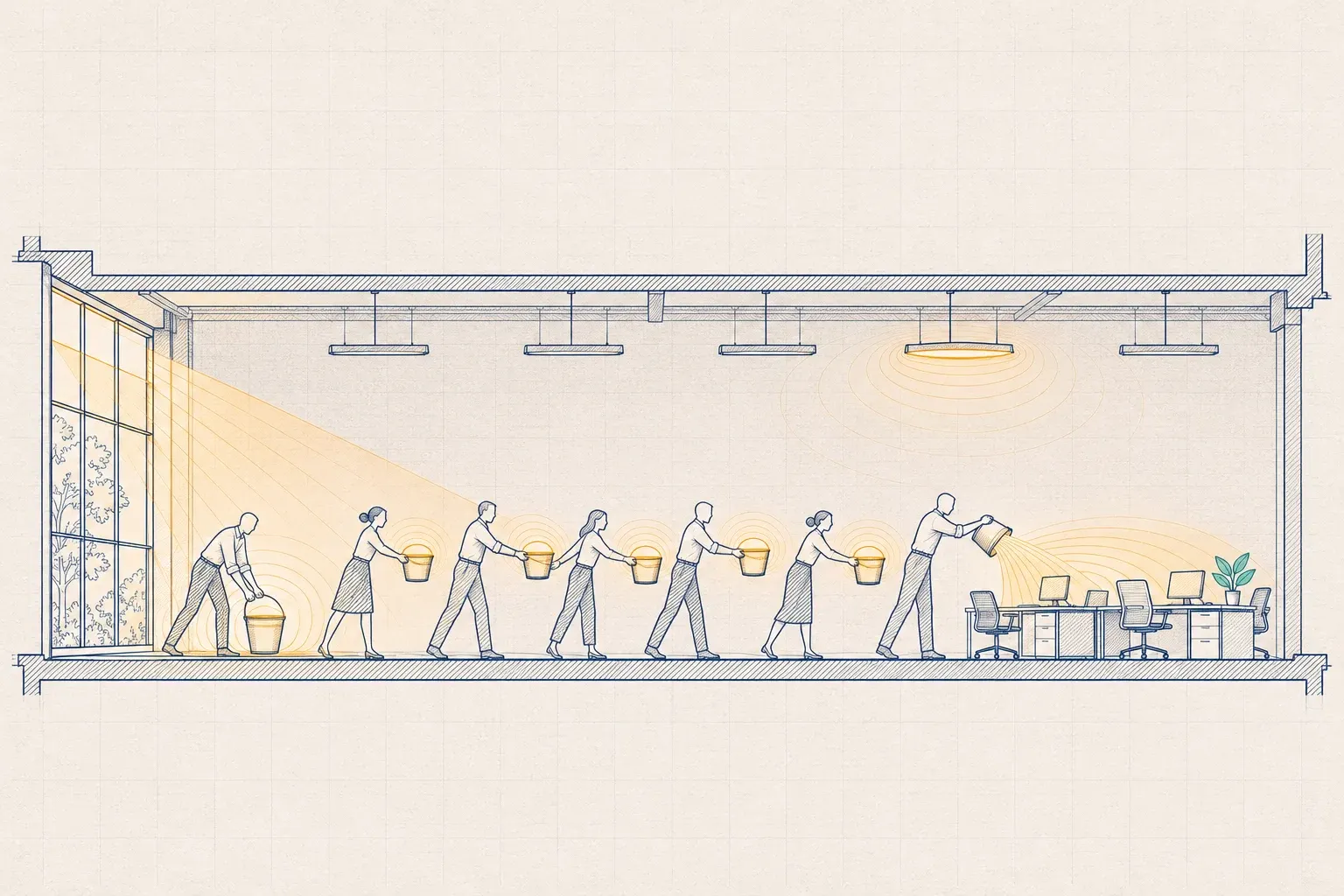
In a sectional view of an office, a line of small figures passes buckets of light from a tall window to desks deep in the floor, beneath mostly dimmed ceiling fixtures.
Plate E-04The light that comes through the glass is the only light that arrives without a bill.

What changes when we're done

Tunable white, daylight harvesting and glare control informed by ANSI/IES RP-46-25, with the energy tradeoff modeled before anything is specified.

  • More daytime light reaching people's eyes where they actually sit, not just more light on the desk
  • Daylight used first, so electric light fills the gap instead of competing with the window
  • Fewer glare complaints from screens, windows and bright downlights
  • An energy model that shows the cost of each wellbeing goal before you commit to it
  • Tunable white schedules that facilities staff understand, can override and can maintain

What's included

Every engagement is scoped to the building, but these are the parts we won't skip.

E-04.01

Goals workshop

We agree what you are trying to achieve, such as alertness in a control room, rest in patient rooms or comfort in classrooms, and which of those goals are worth paying for in energy.

E-04.02

Daylight analysis

Window orientation, shading, interior surfaces and furniture layout, used to draw daylight zones and set a blind and shade strategy that the controls can work with.

E-04.03

Light-at-the-eye modeling

We model vertical light at eye height and its spectrum, using metrics such as melanopic EDI (CIE S 026), alongside conventional horizontal illuminance on the task.

E-04.04

Glare review

Luminaire selection, optics, aiming and shielding checked against screen positions, sight lines and window brightness.

E-04.05

Tunable white sequences

Color temperature and intensity schedules by space type, with daylight interaction, override behavior and evening limits written into the Sequence Book.

E-04.06

Energy tradeoff model

Annual lighting energy for each candidate strategy, compared with a conventional design, so you choose with the cost visible.

How it works

The same steps on every project, so you always know what happens next and what you'll receive.

  1. Workshop and survey

    We meet with the people who own the goals (clinical leads, principals, facility managers) and walk the spaces at different times of day.

  2. Model the options

    Two or three design strategies, each with modeled light at the eye, glare risk and annual lighting energy, presented side by side.

  3. Bench the fixtures

    Tunable white fixtures and drivers from the shortlist go on the Lytbit Lab bench to check color consistency while dimming, flicker, and how DALI-2 DT8 or dual-channel 0-10V control behaves.

  4. Specify and sequence

    Performance specifications for competitive bid, plus the schedules and daylight sequences that make the design work after handover.

  5. Commission and verify

    We measure at eye height after installation, tune the schedules, and return after the first season to check them against how the space is really used.

You receive

Deliverables

  • Design intent memo: goals, metrics and the tradeoffs you approved
  • Daylight zoning and shade strategy drawings
  • Lighting calculations including vertical illuminance at eye height
  • Tunable white and daylight schedules in the Sequence Book
  • Energy tradeoff model comparing the design strategies

How it's scoped

Fixed-fee design package per space type, with an optional post-occupancy verification visit

  • Usually delivered with controls design, since tunable white and daylight harvesting live in the same sequences of operation.
  • Post-occupancy verification is a fixed-fee visit after the first season: measurements, occupant feedback and schedule tuning.
  • We don't sell fixtures, so luminaires are specified for competitive bid like the rest of the design.

Good fit if

Who this is for

  • Healthcare, education, control rooms or offices where occupant wellbeing is a stated project goal
  • Projects pursuing a wellness certification that need a clear energy picture
  • Buildings with good daylight that the current lighting ignores
  • Owners who bought tunable white fixtures and have never seen them change

The decision: what light is worth paying for

Human-centric lighting is sold as a feature you add. It is better understood as a budget you spend. Every goal for alertness, mood or sleep comes down to how much light reaches people’s eyes, at what time, with what spectrum, and each of those has an energy cost. The design question is which goals justify that cost in your building, and which delivery strategy makes it smallest.

Daylight first

The cheapest light in the building comes through the windows, and it is already the spectrum and intensity that people’s bodies respond to. Most buildings waste it: blinds stay down because of glare, and the electric lighting runs at full output beside a sunny window.

Our designs start with daylight. We draw daylight zones from the real window geometry, specify shades that cut glare without blacking out the view, and set daylight-harvesting sequences so fixtures near the glass dim as daylight rises. Done well, daylight harvesting both saves energy and delivers the daytime light that circadian guidance asks for. Done poorly, it hunts, flickers and gets disabled within a month, which is why we commission every daylight zone.

Light at the eye, not just on the desk

Conventional lighting design measures horizontal light on the work surface. ANSI/IES RP-46-25 moves attention to the non-visual effects of light in daytime interiors, which depend on light arriving at the eye. That changes design choices:

  • Walls and vertical surfaces in the field of view matter more than the desk.
  • Where people sit and which way they face matters as much as fixture spacing.
  • Timing matters: bright, cooler light in the morning; warmer, lower light toward evening in spaces that stay occupied.

We model vertical illuminance at eye height and spectral metrics such as melanopic EDI alongside the usual calculations, so the design is judged on what occupants actually receive.

The energy tradeoff, plainly

DOE research on office design found that meeting circadian targets can raise lighting energy considerably, and that strategy decides how much. Here is how we compare the common strategies. The ratings are qualitative and depend on the space.

Strategy Light at the eye Lighting energy Our view
Raise overhead light levels everywhere, all day High Highest Rarely justified
Daylight first, with shade control and dimming High near windows Lower Start here in every daylit space
Light on vertical surfaces near seating Moderate to high Low to moderate Often the best value; watch glare
Tunable white with a morning boost, occupancy-aware Moderate to high when it counts Moderate Good for fixed seating such as nurse stations or control rooms
Personal task lights with tunable spectrum High for the individual Low Effective; depends on occupant habits

We show you the modeled annual energy for each strategy before anything is specified. Wellbeing goals are worth pursuing; they are not worth pursuing blind.

Glare is the fastest way to lose occupants

A design that delivers the right light at the eye and also puts a bright downlight in someone’s peripheral vision will be switched off, taped over or complained about. We check optics, aiming and shielding against screen positions and window brightness, and we prefer indirect and wall-washing components near seating over higher-output downlights.

Tunable white that actually tunes

Many tunable white systems are commissioned once to a single color temperature and never change again. We write the schedules into the Sequence Book, test DALI-2 DT8 or dual-channel 0-10V control on the Lytbit Lab bench before specifying, and verify the schedules after the first season. For a worked example, see our representative outpatient clinic scenario.
FAQ

Questions we hear often

Still unsure? Write to sales@lytbit.com and a person will answer within one business day.

Does circadian lighting use more energy?

It can. DOE research found that meeting circadian lighting targets in office space can raise lighting energy considerably, and that the design strategy makes a large difference. Brighter overhead light everywhere is expensive. Daylight first, light directed toward the eye, and occupancy-aware schedules cost much less. We model this before you choose.

What is ANSI/IES RP-46-25?

It is the IES recommended practice for daytime interiors and the non-visual effects of light. It shifts attention from light on the desk to light reaching people's eyes, and to the timing and spectrum of that light. We use it as design guidance alongside the energy code and your own goals.

Is tunable white the same as human-centric lighting?

No. Tunable white is a tool: fixtures that can change color temperature. Human-centric design is the decision about how much light reaches people, when and with what spectrum. Many tunable systems are installed and left at one setting, which adds cost without any benefit.

Does daylight harvesting really work?

When zones, sensors and calibration are right, yes. Most failures are commissioning failures: photosensors aimed at the wrong surface, zones drawn across the wrong rows of fixtures, or dimming that hunts at dusk. We commission daylight zones and recheck them seasonally.

Can you add tunable white to an existing system?

Sometimes. It needs tunable fixtures or retrofit kits and a control path for two channels, such as DALI-2 DT8 or dual-channel 0-10V. We check on the bench whether your existing controls can drive them before recommending a path.

Tell us about the building.

Floor plans, utility bills and a list of what bothers you are enough to start. We reply within one business day with what we would look at first.