Lytbit Lab

Lytbit Lab: the interoperability bench

Datasheets say devices are compatible. The bench tells us whether they actually behave together on the firmware you'll receive. Everything we recommend has been wired up here first, or we tell you that it hasn't.

ProjectLytbit · Smart lighting & IoT
SheetG-03
Rev26.11
DisciplineInteroperability
DrawnLytbit Engineering
Scale1 : 1
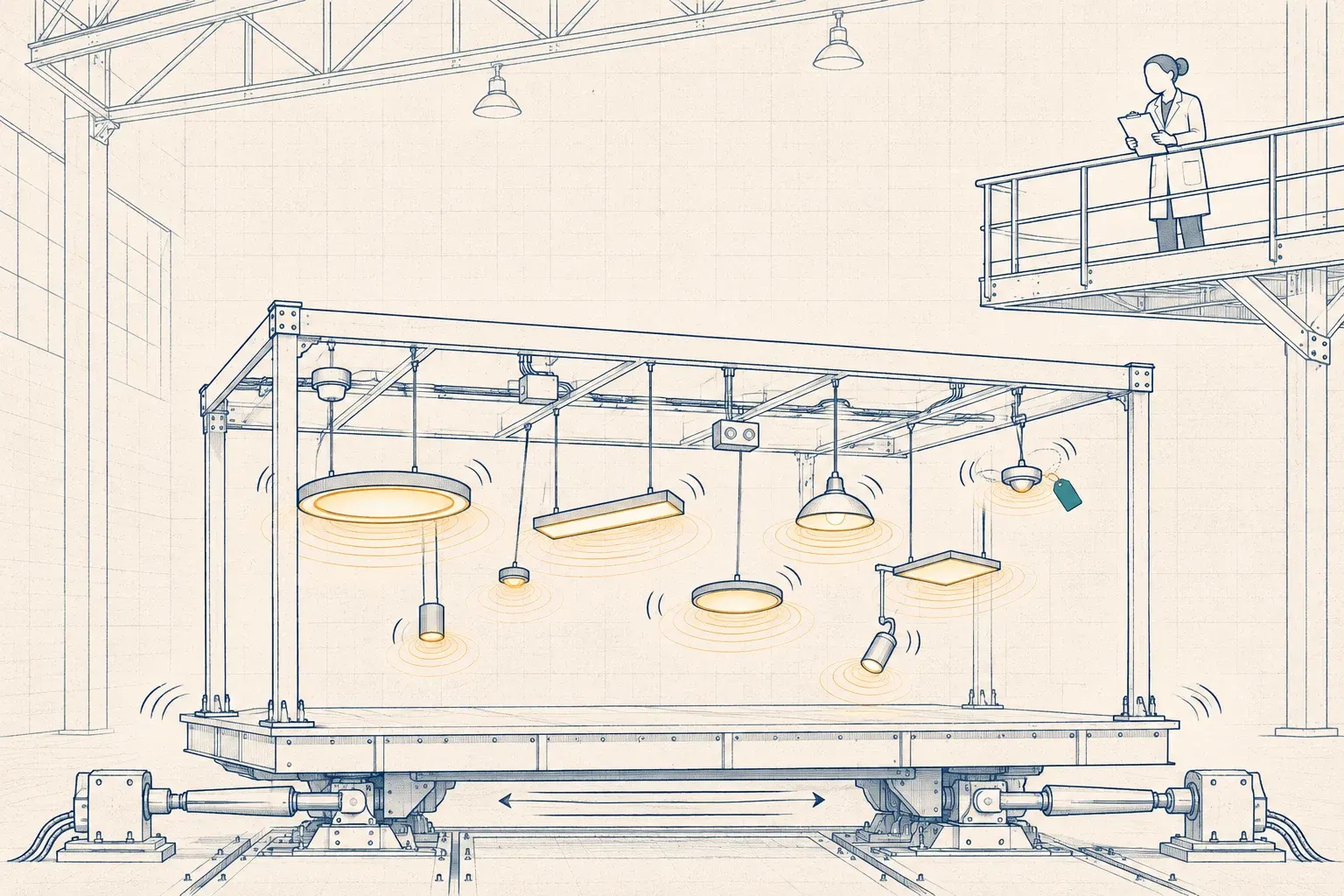
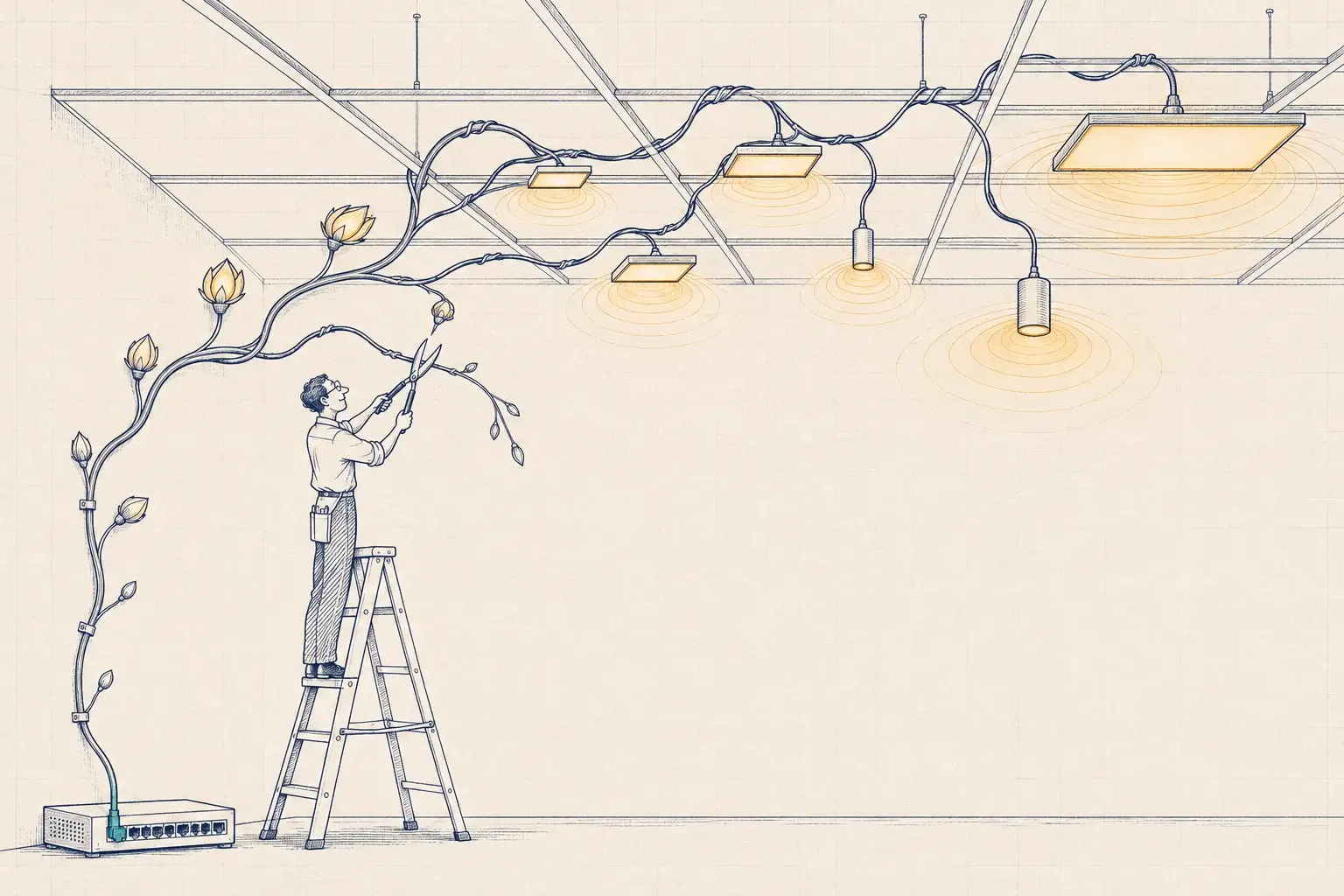
A ceiling mock-up with hanging light fixtures and sensors sits on a shaking test platform, with one sensor swinging out of step while an engineer watches from above.
Plate G-03Better to find the loose joint while the ceiling is still on the table.

What's on the bench

The Lab sits in our Tupelo office, a few steps from the engineers who use it. It is built to reproduce real buildings, so we keep current and previous firmware on hand, not just the latest catalog.

01

Controllers and sensors from multiple ecosystems

Wired room controllers, wireless luminaire-level sensors, and gateways from several manufacturers, so we can reproduce the mix that's actually in your building.

02

DALI-2 and 0-10V drivers

A rack of drivers, including D4i units that report energy and diagnostics, for checking dimming curves, low-end stability, flicker near the bottom of the range, and what a sensor reads back.

03

PoE switches

IEEE 802.3bt switches and PoE luminaire nodes with power metering on each port, so we see standby draw as well as full-output wattage.

04

BACnet test network

A BACnet/IP segment with a test head-end and a BACnet/SC hub, so lighting points can be mapped, named, and checked before an integrator bills for them.

05

Packet capture for security review

A mirrored switch port and capture workstation. We record what each device sends, where, and how often, and hand your IT team evidence instead of assurances.

06

A Ledger test workspace

A Lytbit Ledger instance fed by the bench, to confirm that energy, occupancy, and fault data arrive with the right names and units.

How a pilot works

A pilot answers one question in one or two real spaces before you commit a whole building to an answer.

  1. Define the question

    One sentence, agreed in writing, such as: will these high-bay sensors hold the aisles at low level without false trips from racking? Plus the measurement that will settle it.

  2. Build the kit on the bench

    We assemble a pilot kit of controllers, sensors, and a gateway, load the firmware, and pre-program the sequence, so field time is spent installing, not configuring.

  3. Install and measure

    Your contractor or ours installs the kit in representative spaces. Lytbit Ledger logs energy, occupancy, and faults for an agreed period that covers the conditions that matter.

  4. Report and decide

    You get a Bench Note with the data. Keep the kit, scale it up, or have it removed. The decision is yours, and so is the data.

Open questions we're testing

These are the questions owners, engineers, and IT teams bring us most often. We publish what we find as Bench Notes, including the results that turn out inconclusive.

  • Matter in tenant spaces. Can tenant-installed Matter devices coexist with base-building controls without crossing onto the base-building network? Matter doesn't yet define commercial lighting control device types, so we're testing coexistence, not recommending it.
  • PoE standby power. How many watts per fixture does a PoE lighting system draw with every light off, counting the switch and the node? Lower installation cost can be eroded by standby draw over a long night.
  • Bluetooth Mesh NLC across brands. Do occupancy and ambient light sensors from one manufacturer reliably drive luminaires from another through the NLC profiles, and what breaks when one side updates its firmware?
  • D4i energy data for M&V. How close do D4i drivers' energy readings come to a revenue-grade meter on the same circuit, across the full dimming range?
  • Occupancy to HVAC. Which lighting occupancy signals are stable enough for a BMS to set back air handling, now that DLC NLC 5.2 adds HVAC integration?
  • BACnet/SC on lighting gateways. How do gateways behave behind a BACnet/SC hub, and what does certificate renewal look like for a facility team in year three?
  • Wireless in metal buildings. How far do sensors reach in racked warehouses and cold storage, and at what point do repeaters become a maintenance burden?

Why a controls company needs a bench

“Compatible” on a datasheet usually means two devices share a protocol. It doesn’t tell you whether a sensor’s hold time and a driver’s fade rate add up to a pause that annoys people, whether a gateway drops points under load, or whether a firmware update on one side quietly breaks the other. Those are the problems that create callbacks, and almost none of them show up until the system is in a ceiling.

So we test the combination before it gets there. Our rule on projects is the same one we apply to commissioning: test everything, even the parts that “just work”. The bench simply moves that rule upstream, to a place where a failure costs an afternoon instead of a lift rental and a second site visit.

Bench Notes

Every test produces a Bench Note. Each one follows the same structure:

  1. The question, in one sentence.
  2. The setup: device categories, protocols, firmware versions, wiring, and network configuration.
  3. The procedure: what we triggered, measured, and logged.
  4. The results, with the data attached.
  5. What we’d do: our recommendation, and the conditions under which it would change.
  6. Open issues: what we couldn’t resolve, and who we’ve asked.

Project Bench Notes go to the client as part of the approach. Notes on general questions are published on our blog under the Lytbit Lab byline, so engineers and owners who never hire us can still use them.

What the lab is not

The Lab is not a certification body. A Bench Note doesn’t replace a DLC listing, DALI-2 certification, or a BACnet Testing Laboratories listing; it answers the narrower, more practical question of whether specific devices work together in a specific sequence.

It’s also not a showroom. Nothing is on the bench because someone paid to put it there, and no manufacturer can buy a favorable write-up. That independence is the reason the bench exists.

Starting a conversation with the lab

Use the form on this page or write to lab@lytbit.com. The most useful first message includes the devices involved and their firmware versions, the question you need answered, your deadline, and whether the results can be published. A person replies within one business day. If you can, include photos of the device labels; firmware and hardware revisions are often printed there.

For protocol background before you write, see our integrations directory, our guidance on PoE lighting, and our IoT hardware integration service.
Talk to the Lab

Bench tests, pilots, integration questions and manufacturer conversations go straight to the engineers who run the bench.

Building type, size, location and what's bothering you is plenty. Please don't send passwords or network credentials.

FAQ

Questions we hear often

Still unsure? Write to sales@lytbit.com and a person will answer within one business day.

Can we visit the lab?

Yes, by appointment at our office at 431 West Main Street, Suite 306, in Tupelo. Bring the device that's giving you trouble and its firmware version if you know it.

Do you charge for bench testing?

Bench work on our own projects is part of the Bench step in our method. Standalone tests and pilots are scoped as a fixed fee per question, agreed in writing before we start. The fee never depends on the result.

Will you publish results about a specific product?

Public Bench Notes describe devices by protocol and category, with enough setup detail to reproduce the test. Manufacturer-requested tests are reported to the manufacturer. Project Bench Notes, with full model and firmware detail, go to the client who commissioned them.

How long does a pilot run?

Long enough to cover the conditions that matter: a few weeks for an office, a full shift cycle including weekends for a plant, and longer if seasonal daylight is the question. We agree on the period when we define the question.

Is a Bench Note a certification?

No. A Bench Note records what we observed on our bench. It is not a listing, a certification, or an endorsement. Programs such as the DLC Qualified Products List, DALI-2 certification, and BACnet Testing Laboratories listings do that work, and we check them on every project.

Have a combination you're unsure about?

Send the device list and firmware versions to lab@lytbit.com, or use the form on this page. We'll tell you whether we've benched it and what we'd test.