Resources · Tool

Lighting control protocol explorer

Twelve protocols and data models, side by side: what each one carries, where it fits, and where it bites. Filter by family to see one layer of the system at a time.

ProjectLytbit · Smart lighting & IoT
SheetR-02
Rev26.11
DisciplineProtocols
DrawnLytbit Engineering
Scale1 : 1
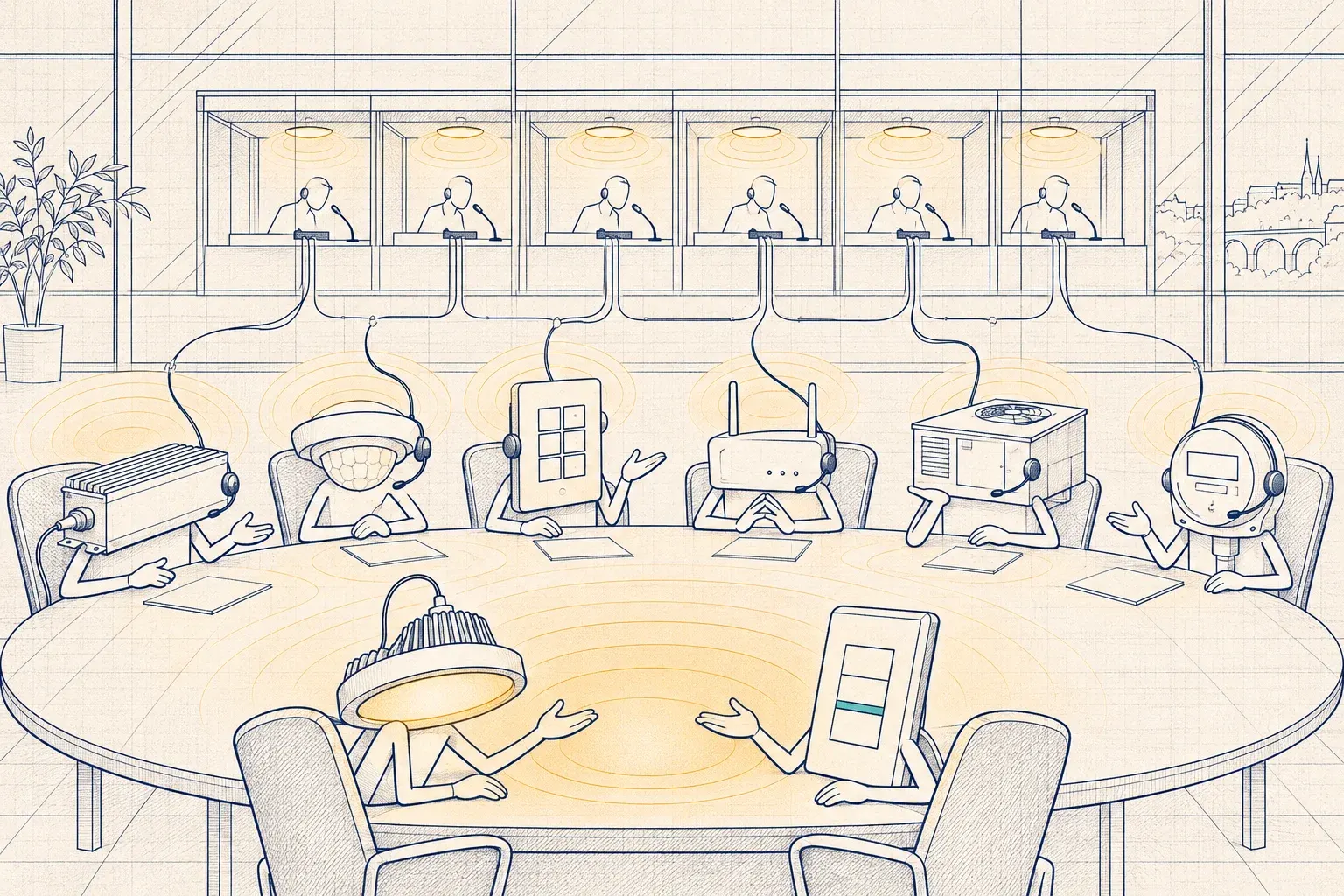
Lighting devices seated at a conference table wear headsets wired to interpreters in glass booths, while two devices at the near end speak directly and glow.
Plate R-02Every interpreter between two systems is a chance to lose something in translation.

12 of 12 protocols shown

Wired controlEstablished

0-10V

Medium
A low-voltage control pair run alongside line-voltage power
Topology
One control circuit per zone; no device addresses
Power
Drivers on line voltage; the control pair carries only a small signal current, so a relay or switch handles full off
Best for
Simple zones, budget retrofits, and fixtures controlled by a room controller or wireless node
Watch out
One-way only, with no status or energy data. Low-end performance and dimming curves vary by driver, and long runs or mixed brands in one zone can dim unevenly.
Interop
Near-universal on drivers. ANSI C137.1 improved consistency, but mixing brands in one zone still needs testing.
Wired controlEstablished

DALI-2

Medium
Two-wire, polarity-insensitive digital bus; may share a raceway with power where code and cable ratings allow
Topology
Free-form bus with no loops; up to 64 control gear and 64 input devices per bus, about 300 m maximum, joined by gateways
Power
A bus power supply (up to 250 mA per bus); drivers on line voltage
Best for
Individually addressable fixtures with feedback, smooth deep dimming, tunable white (device type 8), and fault reporting
Watch out
Bus power, address count and cable length limit each bus. Older DALI-1 devices may not behave like certified DALI-2 parts, and addressing takes commissioning time.
Interop
Strong: DALI Alliance certification tests drivers and control devices from different manufacturers against the same standard (IEC 62386).
Wired controlMainstream

D4i / Zhaga-D4i

Medium
DALI-2 inside the luminaire; Zhaga-D4i adds a standard connector on the housing
Topology
Intra-luminaire bus between the driver and one or two sensors or network nodes
Power
The driver supplies auxiliary power to sensors and nodes, so no separate power supply is needed
Best for
Sensor-ready and connected-ready luminaires, plug-in nodes on outdoor and area lighting, and fixture-level energy and diagnostic data
Watch out
D4i standardizes the luminaire end, not the network beyond it. The node you plug in still decides which ecosystem you're in.
Interop
Strong at the luminaire: certified drivers and nodes share power, stored luminaire data and energy reporting.
Wireless meshMainstream

Bluetooth Mesh (NLC profiles)

Medium
2.4 GHz radio
Topology
Managed-flood mesh with relay nodes; Mesh 1.1 adds directed forwarding
Power
Line-powered fixtures and sensors relay messages; battery switches and sensors usually don't
Best for
Wireless retrofits and luminaire-level control where pulling control wire is expensive, at room-to-floor scale
Watch out
Cross-brand operation holds only for products qualified to the same NLC profiles. Dense metal and racking need an RF check on site, and large meshes need careful subnet planning.
Interop
Improving: NLC profiles for occupancy, ambient light, dimming, energy monitoring and HVAC integration let qualified devices from different manufacturers work together within the profile's scope.
Wireless meshMainstream

Zigbee 4.0

Medium
IEEE 802.15.4 radio at 2.4 GHz, with the new Suzi sub-GHz option
Topology
Mesh with a coordinator, routers and end devices
Power
Mains-powered routers; battery-powered end devices
Best for
Buildings already invested in a Zigbee-based ecosystem, and sensor networks that need low power
Watch out
Commercial lighting platforms built on Zigbee often add closed application layers. Version 4.0 is new, so check certification and upgrade paths for each product.
Interop
Moderate: certified devices share the radio and core specification, but commercial platforms frequently layer proprietary features on top.
Wireless meshEmerging

Thread / Matter

Medium
Thread on IEEE 802.15.4 at 2.4 GHz; Matter runs over Thread, Wi-Fi or Ethernet
Topology
IPv6 mesh with border routers to the IP network
Power
Line-powered routers; low-power battery end devices
Best for
Pilots, small offices and spaces where consumer-grade devices are acceptable, and tracking the commercial roadmap
Watch out
No commercial lighting device profiles yet, so no standard way to express commercial sequences, trim or energy reporting. IT will also need to manage border routers and fabrics.
Interop
Strong in principle and proven for consumer devices; unproven for commercial lighting controls.
Network/IPEmerging

PoE (IEEE 802.3bt)

Medium
Category cable carrying DC power and data together
Topology
Star: each fixture or node runs to its own switch port, with a 100 m channel limit
Power
Up to 90 W per port at the source (Type 4); less arrives at the device after cable losses
Best for
Offices and renovations with short runs, an IT team that wants to own the system, and dense per-fixture data
Watch out
Switch standby power and closet cooling; the 100 m limit makes large warehouses impractical. Firmware updates that reboot switches can turn lights off, and cable bundle sizes need checking for heat.
Interop
Power delivery is standardized; the lighting control software on top is usually specific to the platform.
Building automationEstablished

BACnet/IP

Medium
IP networks, UDP port 47808 by default
Topology
Peer devices on IP, with broadcasts for discovery and BBMDs to cross subnets
Power
Not applicable; data protocol
Best for
Sharing occupancy, status and energy points between lighting and the BMS, the most common building automation language in the region
Watch out
No built-in security. Broadcast traffic and BBMD mistakes cause trouble on large networks, and object names and mapping must be agreed in a points list.
Interop
Strong for common objects, and BTL listing helps, but every integration still needs an agreed points list.
Building automationEmerging

BACnet/SC

Medium
IP networks, using TLS-secured WebSockets (ASHRAE 135 Annex AB)
Topology
Hub and spoke through a primary hub with a failover hub; optional direct connections between nodes
Power
Not applicable; data protocol
Best for
BACnet traffic that crosses IT networks, sites where IT requires encryption and authenticated devices, and multi-building campuses
Watch out
Certificates need an owner who issues and renews them. Many installed controllers don't support SC, so expect mixed BACnet/IP and SC networks joined by routers for years.
Interop
Growing. Check for BTL listing of SC on every device, and budget routers where older equipment stays on BACnet/IP. No BBMDs are needed.
Building automationEstablished

Modbus

Medium
RS-485 serial (Modbus RTU) or Ethernet (Modbus TCP, port 502)
Topology
Client-server; daisy-chained serial segments or IP
Power
Not applicable; data protocol
Best for
Reading energy meters, drives, inverters and generators into a gateway or analytics platform
Watch out
Registers carry no names, units or meaning. Register maps differ by vendor and sometimes contain errors, and plain Modbus TCP has no security.
Interop
Universal at the wire level; every device needs a hand-built register map.
Network/IPMainstream

MQTT / Sparkplug

Medium
TCP/IP, with TLS where configured
Topology
Publish-subscribe through a central broker
Power
Not applicable; messaging protocol
Best for
Moving telemetry from gateways to analytics platforms, data lakes and Lytbit Ledger over outbound connections IT is comfortable with
Watch out
Plain MQTT defines neither topic structure nor payload, so every vendor invents its own. Use Sparkplug (ISO/IEC 20237:2023) or a written schema, and secure the broker.
Interop
High with Sparkplug, which standardizes topics, payload encoding and device state; low with improvised MQTT.
Data & semanticsEmerging

Brick / Project Haystack / ASHRAE 223P

Medium
Metadata models: RDF graphs for Brick and 223P, tags and definitions for Haystack
Topology
Not a network; a description of equipment, points and spaces and how they relate
Power
Not applicable; data model
Best for
Making lighting, HVAC and meter data findable by software without hand-mapping, and portfolios that want reusable fault rules and reports
Watch out
A model is only as good as the person tagging, and it has to be updated when the building changes. ASHRAE 223P is still progressing, so confirm its status before you specify it.
Interop
Brick and Haystack have open tooling and ongoing alignment work; 223P draws on both to define a formal standard.

Most protocol arguments are really arguments about different layers. A lighting system has four of them, and each needs its own answer:

  1. At the fixture: how the driver is told what to do. Filter for Wired control to see 0-10V, DALI-2 and D4i.
  2. Between devices: how sensors, switches and fixtures reach each other across a room or floor. Wireless mesh and Network/IP cover Bluetooth Mesh, Zigbee, Thread and PoE.
  3. To the building: how lighting shares data with the BMS. Building automation covers BACnet/IP, BACnet/SC and Modbus.
  4. To the data: how energy and occupancy data travels and what it means. That’s MQTT with Sparkplug, plus Brick, Haystack and 223P under Data & semantics.

A good design picks one answer per layer and names every boundary between them. Each boundary is a gateway, a points list and a place where something can be lost in translation.

How to choose

  • Decide who owns the system in year five. If IT will own it, PoE and BACnet/SC fit its tools and habits. If facilities will run it with one technician, a wireless platform with a good commissioning app may serve better than anything that needs a network engineer.
  • Count the cable you’d have to pull. In an occupied building with hard ceilings, wireless control at the fixture avoids most of it. In new construction with open ceilings, wired DALI-2 is inexpensive to install and easy to diagnose for decades.
  • Name everything the lighting must talk to: a BMS that will use occupancy, a utility demand response program, an analytics platform. Each one is a boundary that needs a protocol and a points list.
  • Prefer certified interoperability to promised interoperability. DALI-2 certification, Bluetooth NLC profile qualification, BTL listing and DLC listing all mean someone tested the claim.
  • Match maturity to your risk tolerance. Emerging isn’t a warning. It means fewer installed examples, so plan a pilot. We run those pilots on the bench in the Lytbit Lab before anything goes in a ceiling.

Combinations we’d avoid

  • 0-10V where deep, smooth dimming matters, such as conference rooms with presentation scenes. Low-end behavior varies by driver; DALI-2 or D4i gives you both control and feedback.
  • PoE in a warehouse. The 100 m limit scatters switches across the building, and standby power adds up across hundreds of ports. Wireless luminaire-level control is usually simpler there.
  • Thread or Matter as the backbone of a commercial lighting system today. Without commercial lighting device profiles, pilot it rather than standardize on it.
  • BACnet/IP on a flat network shared with guest Wi-Fi. BACnet/IP has no built-in security. Segment it, or move links that cross IT networks to BACnet/SC.
  • Two wireless lighting ecosystems with two apps in one building. Each may work alone, but the facility team ends up with two sets of schedules and nobody owns the whole.
  • Plain MQTT with every vendor inventing its own topics. Agree on Sparkplug or a written schema, or you’ll pay to normalize the data forever.
  • Modbus registers piped straight into analytics. Without Brick or Haystack metadata, a register number means nothing to the next person.
  • Wireless mesh in cold storage or dense steel racking without a site survey. Metal, ice and liquids absorb or reflect 2.4 GHz signals, and a bench test can’t replace a walk with a spectrum analyzer.

Where to go next

For a deeper look at dimming interfaces, read 0-10V vs. DALI-2 vs. D4i. For wireless choices, see Bluetooth Mesh, Zigbee 4.0, Thread or Matter? Our integrations and protocols page shows how deeply Lytbit Ledger works with each one. If you have a specific combination in mind, write to lab@lytbit.com.

Have a combination you're not sure about?

Tell the Lab what's in the ceiling and what it needs to talk to. We'll tell you what we'd test on the bench first.