Deploy & Commission

Multi-brand lighting controls commissioning

Most lighting control complaints are not hardware failures. They are settings nobody verified. We test every sequence against the design intent, whatever brand is in the ceiling, and hand you proof.

ProjectLytbit · Smart lighting & IoT
SheetE-06
Rev26.11
DisciplineCommissioning
DrawnLytbit Engineering
Scale1 : 1
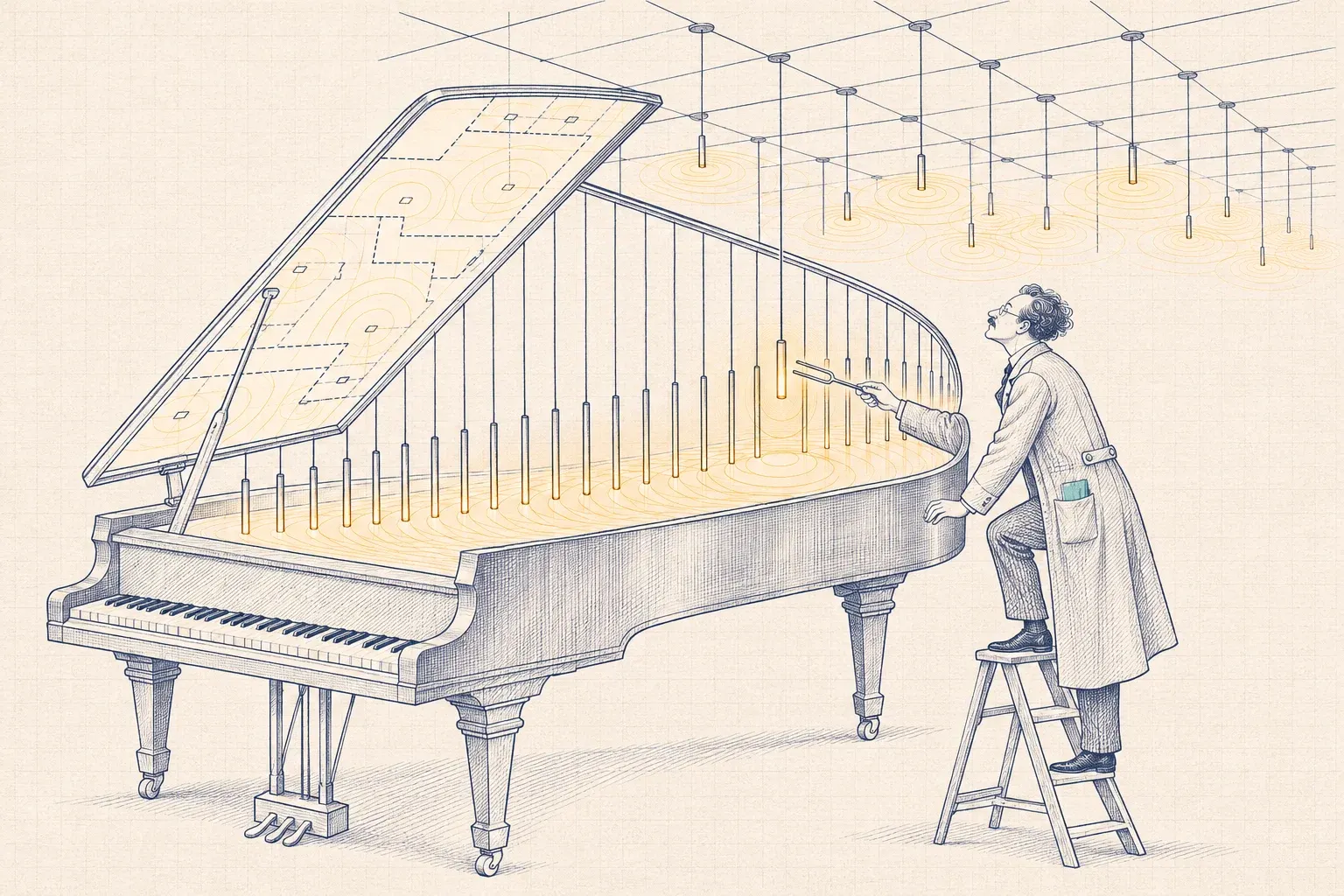
A piano tuner on a stepladder touches a tuning fork to one of many pendant lights strung inside an open grand piano, where the strings would normally be.
Plate E-06A system nobody tunes drifts out of key, one fixture at a time.

What changes when we're done

Functional testing, trim and configuration reports for any brand of networked controls, so the system does what the drawings promised.

  • Every zone, sensor and schedule tested against a written sequence of operations
  • Functional testing documentation your code official and utility program can accept
  • A configuration report you can hand to the next technician, so settings survive staff turnover
  • Fewer callbacks, because occupants stop fighting the system

What's included

Every engagement is scoped to the building, but these are the parts we won't skip.

E-06.01

Pre-functional review

We read the drawings, submittals and sequence of operations before anyone climbs a ladder, and flag gaps such as missing daylight zones, sensors placed behind racking, and schedules that ignore second shift.

E-06.02

Device-level verification

Every sensor, switch, driver and gateway is addressed, labeled and checked against the device schedule, including the DALI-2 or 0-10V dimming range at the fixture.

E-06.03

Functional performance testing

We run each control sequence through its states (occupied, vacant, daylight, after-hours, override, demand response) and record the result, not just the setting.

E-06.04

High-end trim and task tuning

We set maximum light output per zone to what the space actually needs, measured with a calibrated meter, and document the target illuminance next to the trim level.

E-06.05

Configuration report

A complete record of the as-commissioned settings, in ANSI/NEMA C137.9 format where the platform supports it, plus our plain-language Sequence Book for the facility team.

E-06.06

Owner training

Two short sessions: one for the facility team on overrides, schedules and alarms; one for whoever owns the network on firmware, backups and access.

How it works

The same steps on every project, so you always know what happens next and what you'll receive.

  1. Read the intent

    We start from the sequence of operations. If there isn't one, we write one with you, because you can't test against an intent nobody wrote down.

  2. Build the test script

    Each space type gets a script: what to trigger, what should happen, how long it should take. Your team can rerun the same script later.

  3. Test in the field

    Two-person crews test zone by zone, after hours where occupants would be disturbed, and log pass, fail or adjusted with timestamps.

  4. Fix and retest

    Failures go to a punch list owned by whoever can fix them: installer, manufacturer or us. We retest until every line closes.

  5. Hand over

    You receive the configuration report, the test log, the Sequence Book and a backup of the system database, stored in your Lytbit Ledger workspace.

You receive

Deliverables

  • Sequence Book: the plain-language intent for every space type
  • Functional test scripts and signed test logs
  • Configuration report (C137.9 format where supported) and system database backup
  • Trim schedule with measured illuminance per zone
  • Closed punch list

How it's scoped

Fixed fee per building, scoped from the device count and the number of distinct sequences

  • New construction: priced with the design package, or as a standalone line item for the electrical contractor's bid.
  • Existing systems: we start with a one-day sample test of representative spaces, then quote the full building from what we find.
  • Factory startup that a manufacturer requires is coordinated, not duplicated. We witness it and test the sequences on top.

Good fit if

Who this is for

  • You have networked controls from more than one manufacturer and nobody owns the whole picture
  • Your code official or utility program needs functional testing documentation
  • Occupants complain that lights turn off on them, or never turn off at all
  • You inherited a system with no configuration records

Startup is not commissioning

Most manufacturers sell a startup visit. A factory technician addresses the devices, confirms they communicate, loads a default program and leaves. That work matters, but it answers a narrow question: does the hardware work?

Commissioning answers the question you actually care about: does the building behave the way it was designed to? Does the open office dim when daylight is strong enough? Does the warehouse aisle drop to its low level after the forklift passes, and come back before the next one arrives? Does the after-hours sweep run on holidays? Does anyone know what the override button in the break room does?

When those questions go unanswered, occupants answer them for you. They tape over sensors, prop switches and call facilities until someone sets everything to “on”. Industry research on networked controls keeps finding the same barrier: a bad first experience with a poorly configured system makes owners wary of controls for years.

Why multi-brand matters

Commercial buildings rarely have one controls ecosystem. A typical building in our region might have:

  • a wired room-control system in the offices, installed during the last renovation;
  • wireless luminaire-level controls in the warehouse, added with an LED retrofit;
  • a separate exterior and parking controller on a photocell and time clock;
  • a building automation system that would like occupancy data but never gets it.

Each manufacturer will start up its own products. Nobody tests how the whole building behaves. That gap is where we work. We are not tied to a manufacturer, so we test the sequences rather than defend a product line, and we write down what we find.

What we test, specifically

Sequence What “pass” looks like
Occupancy / vacancy Lights respond within the designed delay; vacancy-only spaces never turn on automatically
Daylight response Zones within the daylight area dim proportionally; no visible hunting or flicker at dusk
High-end trim Maximum output matches the trim schedule; measured illuminance meets the design target
Scheduling After-hours sweep, holiday calendar and shift changes behave as written
Overrides Manual overrides time out as designed and are logged
Demand response A test signal sheds the designed amount of load and restores it
Integration Occupancy and energy points reach the BMS or Lytbit Ledger with correct names and units

The paperwork is part of the product

The configuration report and test logs are what keep a system working after we leave. When a technician replaces a sensor three years from now, they need to know what it was set to and why. When a utility program or code official asks for functional testing documentation, you should be able to send it in minutes, not reconstruct it.

We store every deliverable in your Lytbit Ledger workspace and export it as PDF and CSV, so the records outlive any vendor relationship, including ours.

When to call us

  • Before the drywall closes on new construction, so testing is in the schedule rather than squeezed in after occupancy.
  • Before a utility incentive deadline, when functional testing documentation is a condition of payment.
  • When complaints start, because most of them are configuration, not hardware.
  • Every few years, as a re-commissioning pass: buildings change and controls should follow.

If you are not sure where your system stands, a Baseline Assessment includes a sample functional test of representative spaces and tells you whether full commissioning is worth it.

FAQ

Questions we hear often

Still unsure? Write to sales@lytbit.com and a person will answer within one business day.

The manufacturer already did startup. Why test again?

Startup proves that devices talk to each other. Commissioning proves the building behaves the way the design intended: that the conference room dims when daylight is available, that the warehouse aisle drops to 20% after five minutes, that the after-hours sweep actually runs. Those are different questions.

Do you commission brands you didn't design or install?

Yes, that's the point. We work from the sequence of operations and the platform's own tools, and we test on the bench in our Lab first when a combination is new to us.

Does the energy code require functional testing?

Recent editions of ASHRAE 90.1 and the IECC (see section C408.3 in the 2024 IECC) require functional testing of lighting controls, and the 2024 IECC extends testing to controls such as high-end trim and demand-responsive controls where they are installed. Which edition applies depends on your jurisdiction; we confirm it with the authority having jurisdiction at the start of every project.

How long does it take?

A typical 50,000 sq ft office with a single platform takes a few field days plus documentation. Multi-brand systems and occupied buildings that need after-hours work take longer. We give you a schedule with the fixed fee.

Can you re-commission a system that was commissioned years ago?

Yes. Re-commissioning is often the cheapest energy project in the building. Sensors get blocked by new furniture, schedules drift, and overrides become permanent. See our legacy system rescue service if the platform itself is no longer supported.

Tell us about the building.

Floor plans, utility bills and a list of what bothers you are enough to start. We reply within one business day with what we would look at first.