Deploy & Commission

PoE and DC lighting, advisory and pilots

Power over Ethernet lighting works well in some buildings and is the wrong tool in others. We help you tell which before you commit, then prove it on the Lytbit Lab bench and on one floor before it reaches the rest of the building.

ProjectLytbit · Smart lighting & IoT
SheetE-08
Rev26.11
DisciplinePoE Lighting
DrawnLytbit Engineering
Scale1 : 1
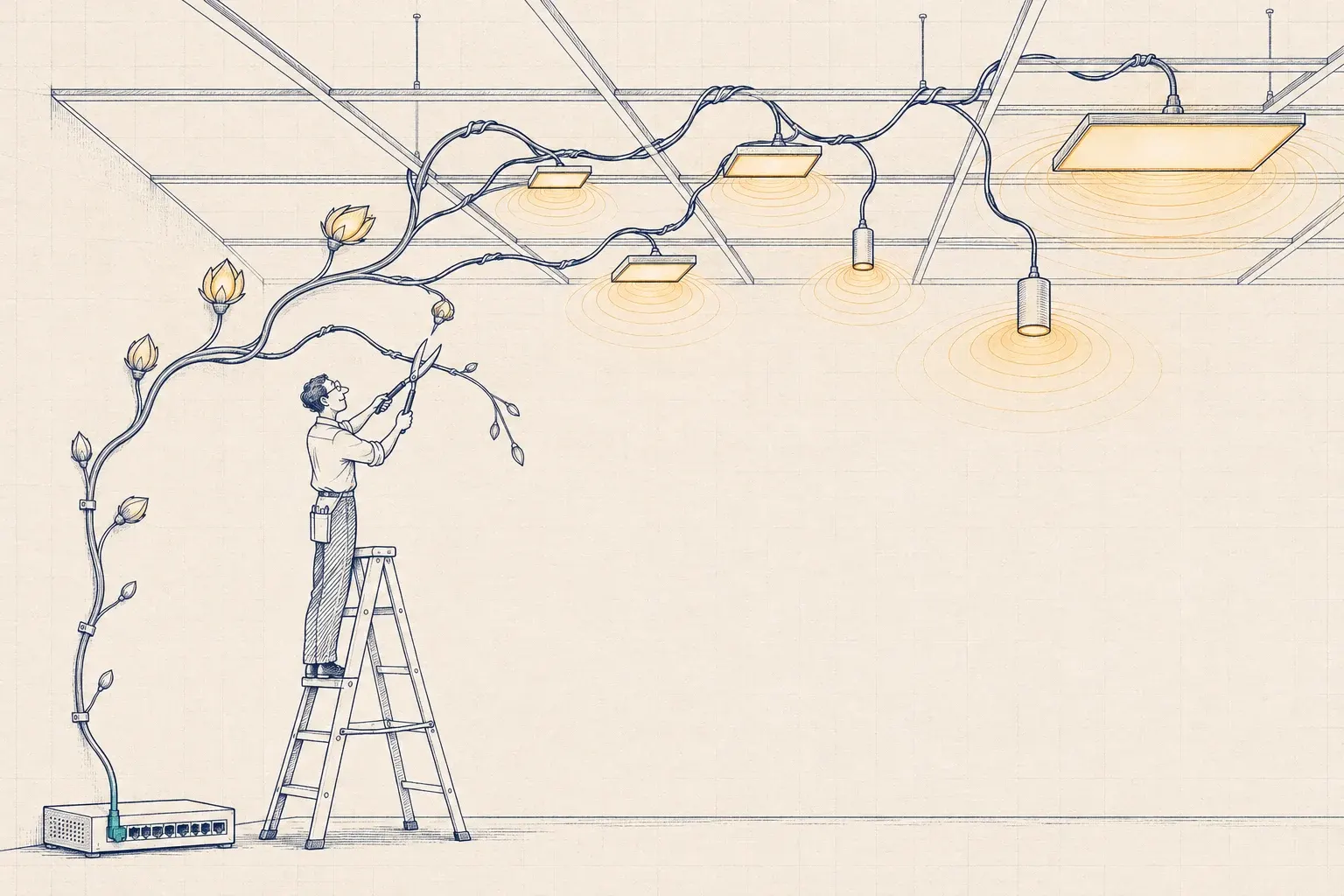
An Ethernet cable rises from a network switch and grows like a vine across a ceiling grid, sprouting small glowing light fixtures as leaves, while a figure on a ladder prunes one branch.
Plate E-08Lighting that grows from the network closet needs a gardener in IT.

What changes when we're done

Advisory and pilots for Power over Ethernet and DC lighting: where it pays, where it doesn't, and how IT and facilities share the result.

  • A straight answer on whether PoE suits your building, floor by floor
  • A pilot that measures installed cost, standby power and occupant experience before you scale
  • Written agreement between IT and facilities on who owns switches, ports, firmware and outages
  • Emergency lighting questions settled with your AHJ before design, not at inspection
  • Switches, nodes and luminaires tested together in the Lytbit Lab before they go in a ceiling

What's included

Every engagement is scoped to the building, but these are the parts we won't skip.

E-08.01

Fit assessment

Fixture density, cable run lengths, ceiling heights, renovation scope and IT maturity reviewed floor by floor, against a conventional or wireless alternative.

E-08.02

Power and standby budget

Port and switch power for the lighting load, plus switch standby draw at night and on weekends, so the energy model includes the network as well as the fixtures.

E-08.03

Ownership model

A written responsibility matrix for IT and facilities covering switch ownership, VLANs, firmware updates, monitoring, spares, and who answers the call when a floor goes dark at 2 a.m.

E-08.04

Emergency lighting review

How egress luminaires stay lit when a switch, a UPS or upstream power fails: which listings apply, whether backup is local or central, and what your authority having jurisdiction will accept.

E-08.05

Lab bench test

Candidate PoE switches, nodes and luminaires tested together in the Lytbit Lab: port power under load, standby draw, reboot and failover behavior, and what the lights do during a firmware update.

E-08.06

Pilot and measurement

One floor or zone installed, commissioned and monitored in Lytbit Ledger for an agreed period, ending in a written go or no-go recommendation.

How it works

The same steps on every project, so you always know what happens next and what you'll receive.

  1. Screen

    A short review of drawings, renovation plans and your network setup tells us whether PoE is worth a closer look or whether we'd recommend another path now.

  2. Bench

    The shortlisted switch, node and luminaire combination is wired up in the Lab and measured, and we publish the results to you as a Bench Note.

  3. Pilot

    A representative area is designed, installed and commissioned, with IT and facilities working to the draft responsibility matrix.

  4. Measure

    Energy, including switch standby, occupancy patterns, faults and occupant feedback are logged over the pilot period.

  5. Decide

    We recommend scaling, adjusting or stopping, with the evidence attached. Stopping is a legitimate result.

You receive

Deliverables

  • PoE fit memo by floor, naming the alternative we'd choose where PoE doesn't fit
  • Bench Note on the tested switch, node and luminaire combination
  • Power, standby and cabling budget
  • IT and facilities responsibility matrix
  • Pilot results and go or no-go recommendation

How it's scoped

Fixed-fee advisory, followed by a fixed-fee pilot scoped by floor area and device count

  • Advisory covers the fit assessment, the ownership model and the emergency lighting review, and can stop there if PoE isn't the right answer.
  • Pilots include Lab bench testing, commissioning of the pilot area and monitoring in Lytbit Ledger for the agreed period.
  • If the pilot succeeds, full-building work is scoped as a design package and a turnkey project.

Good fit if

Who this is for

  • Dense office floors, or renovations where ceilings are open anyway
  • Organizations whose IT team already runs a well-managed switch infrastructure and is willing to own lighting ports
  • Owners who want occupancy and energy data from every fixture
  • Teams that want evidence from a pilot before committing a whole building

The decision: PoE, conventional, or wireless

Power over Ethernet lighting runs low-voltage power and data to each fixture over the same cable, from a network switch rather than a lighting panel. Every fixture becomes a network device with its own address, sensor and energy reading. That is a strong idea, and in the right building it works well.

It is also a different way of owning lighting. The fixtures depend on switches, the switches depend on IT, and the energy bill now includes network gear that runs all night. So the question is whether PoE fits your building, or whether a conventional or wireless system would serve you better. We treat PoE as advisory and pilot work for that reason: we would rather prove it on one floor than recommend it for every floor.

Where it pays and where it doesn’t

Building or space Our view Why
Dense open office floor, ceilings open for renovation Good candidate Short runs, many fixtures per switch, IT ownership, rich sensor data
Historic or hard-to-rewire office building Worth a pilot Low-voltage cabling can simplify pathways; confirm local requirements first
Healthcare and labs Case by case Emergency power, infection control and uptime requirements add complexity
High-bay warehouse or plant Not recommended Long runs, high fixture wattage and sparse layouts
Parking structures, long corridors, exterior Not recommended The 100-meter channel limit and environmental exposure
Small building without managed IT Not recommended Nobody to own the switches

Standby power is the cost nobody models

A lighting panel sits idle at night. A PoE switch doesn’t. Switches draw power around the clock, so a floor that is dark from 7 p.m. to 7 a.m. and all weekend still consumes energy in the closet. A GSA trial of PoE lighting found lower installation cost but higher standby power, and that matches what we see on the bench.

Our energy model includes measured switch standby, not just fixture watts. In some buildings PoE still comes out ahead. In others, the standby draw erases the controls savings that made it attractive.

IT and facilities have to agree who owns it

PoE puts lighting on the network, which raises questions that conventional controls never did. Who approves a switch firmware update that will reboot a floor’s lights? Who carries spare switches? Who gets the alert when a port fails, and who answers occupants when a zone goes dark? We write a responsibility matrix with both teams before design, and we treat the lighting network as part of your building network security scope.

Emergency lighting questions to settle first

Egress lighting must stay on when normal power fails, and with PoE it also depends on switches and network power. Before design we answer, with your authority having jurisdiction:

  • how emergency luminaires are powered: local battery, central inverter or switches on backup power;
  • which listings the emergency path relies on, such as UL 924 for emergency lighting equipment;
  • what happens to egress lighting during a switch reboot or failure;
  • how the emergency path will be tested and documented.

What the Lab tests

The Lytbit Lab keeps PoE switches on the bench alongside drivers, sensors and controllers from several ecosystems. For a pilot we measure port power under load against the IEEE 802.3bt budget, standby draw, behavior during reboot, failover and firmware updates, and whether the lights come back in their last state or at full output. The results become a Bench Note you keep.

DC lighting beyond PoE

PoE is one form of DC lighting. Centralized DC power distribution and low-voltage lighting circuits raise similar questions about ownership, standby losses and listings. We assess them the same way: advisory first, a pilot if the case holds up. See a representative historic office PoE scenario for how a pilot can be structured.

FAQ

Questions we hear often

Still unsure? Write to sales@lytbit.com and a person will answer within one business day.

Where does PoE lighting pay off?

On dense office floors and in renovations where ceilings are open anyway and IT already owns a well-run switch infrastructure. Short cable runs, many fixtures per switch, low-voltage cabling and a sensor in every fixture can make a strong case there.

Where doesn't it?

We don't recommend PoE for high-bay warehouses or spaces with long cable runs. An Ethernet channel is limited to 100 meters, many high-bay fixtures need more power than one port delivers, and fixtures are spread far apart. Wireless luminaire-level controls are usually the better fit there; see our wireless retrofit service.

How much power can a PoE port deliver?

IEEE 802.3bt allows up to 90 W per port at the source. Some of that is lost in the cable, so the fixture receives less, and large bundles of cables carrying high power run warm, which affects cable selection and bundle sizes.

Doesn't PoE add standby power?

Yes, and it is easy to leave out of the business case. Switches draw power around the clock, including nights and weekends when the lights are off. A GSA trial found lower installation cost but higher standby power. We measure switch standby on the Lab bench and include it in the energy model.

How is emergency lighting handled?

Carefully. Egress lighting has to stay on when normal power or the network fails. Ask how emergency luminaires are powered, which listings apply (UL 924 covers emergency lighting equipment, for example), and whether switches sit on backup power. We review the approach with your AHJ before design.

Who owns a PoE lighting system, IT or facilities?

Both, which is why it has to be written down. IT usually owns switches, ports and firmware; facilities owns sequences, fixtures and occupant complaints. Our responsibility matrix settles the gray areas before installation, and our cybersecurity service covers network segmentation.

Considering PoE for a floor or a building?

Send the floor plan and tell us who runs your network. The Lab will tell you what we'd test first.