Industries

Hotel lighting controls

Guests should notice the light, never the controls. We design hotel sequences that save energy in empty rooms, corridors, and back of house, and keep every guest-facing moment calm, warm, and predictable.

ProjectLytbit · Smart lighting & IoT
SheetA-08
Rev26.11
DisciplineHospitality
DrawnLytbit Engineering
Scale1 : 1
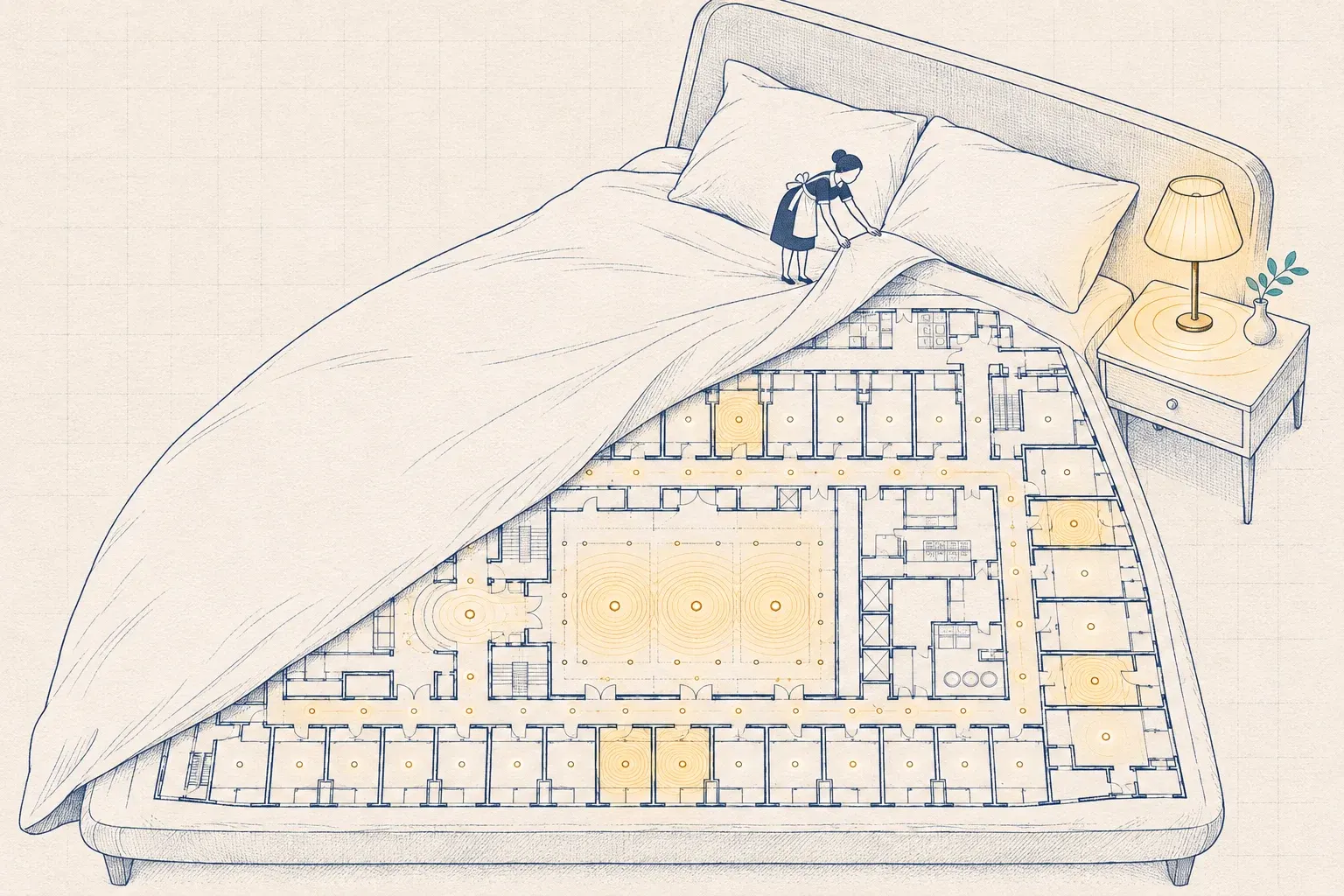
A hotel bed with one duvet corner folded back for turndown; underneath, instead of sheets, is a drawn ceiling plan of the hotel with a few rooms glowing, while a tiny housekeeper smooths the fold.
Plate A-08The system belongs under the covers, folded where guests never see it.

What makes these buildings hard

Guest room, corridor, ballroom, and back-of-house controls that save energy where guests don't notice and never turn lights off on them.

Condition 01

Sleeping guests look like empty rooms

A motion sensor can't see someone asleep. Rooms that rely on motion alone switch off on guests or set back the thermostat at 2 a.m.

Condition 02

Corridors and lobbies that never sleep

Guest corridors need light all night, but full output in an empty corridor at 4 a.m. is energy spent on nobody.

Condition 03

Ballrooms change every day

A ballroom may host a breakfast, a presentation, and a wedding in one day, with partitions combining and dividing the room. Keypads multiply, and staff forget which one does what.

Condition 04

Back of house runs like a small plant

Laundry, kitchens, housekeeping, and engineering run long hours, often on controls nobody has revisited since opening day.

What we'd do about it

Control strategies that hold up in this building type, in the order we usually apply them.

  1. Guest room logic that knows who's in

    Door switches and occupancy sensors together decide whether a room is occupied, so lights and switched outlets turn off after guests leave, and never while they sleep.

  2. Corridors that dim but never darken

    Corridors hold a low level overnight and come up as guests approach, with egress levels always maintained.

  3. Scenes that follow the partitions

    Ballroom scenes for banquets, presentations, dancing, and cleaning, with partition sensors so each keypad controls the right room when walls move.

  4. Back of house on schedules and occupancy

    Laundry, kitchen, and storage areas follow shift schedules and occupancy, with safety levels kept near cooking and equipment.

Typical control sequence by space type

Starting points for hotels, adjusted to brand standards and confirmed with the general manager and chief engineer.

SpaceStrategyTypical setting or behaviorNotes
Guest roomsDoor switch plus occupancy logicLights and switched outlets off after the room is vacated; nothing turns off while the door stays closed with someone insideLow night-light path to the bathroom
Guest corridorsOccupancy dimmingLow level when empty, never dark; full output as guests approachEgress levels always maintained
Lobby and public areasAstronomical schedule, daylight, and scenesDay, evening, and late-night scenes; daylight dimming near glassWarmer, dimmer scenes in the evening
Ballrooms and meeting roomsScenes plus partition sensingBanquet, presentation, dance, and cleaning scenes; keypads follow partition positionsCleaning scene times out
Restaurant and barScheduled scenesBreakfast, lunch, dinner, and late scenes by time of dayStaff can adjust within set limits
Kitchen and laundrySchedule plus occupancyFull output during operating hours; occupancy after hoursNo automatic off near active cooking
Housekeeping, storage, and engineeringOccupancy or vacancyOff after a short delayA common place for overrides left on
Parking, entrances, and poolDusk-to-dawn with dimmingEntrances at full output overnight; parking dims late with motion responsePool and grounds lighting per local requirements

Where to save, and where not to try

The question for a hotel is where it can save lighting energy without a single guest noticing, and where it shouldn’t try. In hospitality, the guest experience comes first, and controls a guest can perceive are controls done wrong.

Guest rooms: the occupancy question

Guest rooms are where a hotel spends the most lighting energy on nobody: rooms lit after checkout, lamps left on all day while guests are out, bathroom lights burning through the night. Recent energy codes require guest room lighting and switched receptacles to turn off automatically once the room is vacated.

The hard part is knowing when a room is actually vacant. A motion sensor alone can’t see a sleeping guest, and a room that switches off or warms up at 2 a.m. produces a complaint and, eventually, a disabled sensor. The reliable answer combines a door switch with occupancy sensing:

  • The door opens and closes, and the sensor sees motion: the room is occupied, and it stays occupied until the door opens again, however still the guest is.
  • The door opens and closes, and the sensor sees nothing for a set time: the room is vacant, and lights and switched outlets turn off.

The same logic can set back the thermostat in a vacant room, which is often a larger saving than the lighting itself. We connect it through the guest room management system or the BMS, and we test it with staff playing guests.

Corridors, lobby, and public spaces

Corridors run all night and are empty for most of it. Our sequence dims them to a low level when nobody is there and brings them up as a guest steps off the elevator, always above egress minimums. Guests rarely notice the dimming. What they notice is a corridor that is dark when they arrive, so we never allow one.

Lobbies get time-of-day scenes: bright and daylight-responsive by day, warmer and dimmer in the evening, and a quiet late-night scene after the bar closes. Restaurants and bars follow their service periods.

Ballrooms and meeting rooms

Ballrooms are a scenes problem. A typical day might include a breakfast, a training session with projection, and an evening reception, with partitions moving between events. We build a short list of named scenes, link keypads to partition sensors so the right keypad controls the right room when walls move, and add a cleaning scene that times out. Banquet staff get a one-page guide, not a manual.

Dimming quality matters more in hospitality than almost anywhere else. Decorative fixtures, warm dimming, and slow fades need drivers and protocols that dim smoothly to low levels. We check those combinations on the bench in our Lab before they reach a ballroom ceiling.

Back of house

Laundry, kitchens, housekeeping, engineering shops, and storage behave like a small industrial building. They run long hours, often on the same switches since opening day. Shift schedules and occupancy sensing save energy here without affecting guests at all, which makes back of house the easiest first phase in many hotels. Near active cooking and equipment, safety levels stay on while staff are working.

Brand standards and the energy code

Branded hotels have lighting standards, energy codes have requirements, and the two don’t always agree. We document where they pull in different directions so you can settle it with the brand before construction, not after inspection.

Incentives and code

Hotels in TVA territory can apply through EnergyRight, which requires pre-approval before purchase and gives additional credit for networked controls. Entergy Mississippi and Mississippi Power customers have their own commercial programs. We prepare the applications and coordinate with your local power company and program staff.

Energy code adoption varies by state and jurisdiction. We confirm the applicable edition with the authority having jurisdiction, and we provide the functional testing documentation that ASHRAE 90.1-2022 and the 2024 IECC call for in lighting controls.

What we’d do first

Spend a night as a guest and a morning with the chief engineer. Between the guest room, the corridor at 3 a.m., and the laundry at 6, we’ll know where the savings are.
FAQ

Questions we hear often

Still unsure? Write to sales@lytbit.com and a person will answer within one business day.

Will occupancy controls turn the lights off on our guests?

Not if the room logic is right. We combine a door switch with occupancy sensing: once the door closes with someone inside, the room stays occupied until the door opens again. A sleeping guest keeps the light they chose, and the thermostat stays where they set it.

Do energy codes require guest room controls?

Recent editions of the energy codes require guest room lighting and switched receptacles to turn off automatically after the room is vacated, with some exceptions. Which edition applies depends on your jurisdiction, and we confirm it with the authority having jurisdiction.

Can guest room occupancy also control the thermostat?

Yes, and that's often where the larger savings are. The same occupancy logic can set back heating and cooling in vacant rooms through the guest room management system or the BMS. See using lighting occupancy data to set back HVAC.

Can you retrofit an operating hotel without closing floors?

Usually. Wireless controls let us work room by room as rooms turn over, and corridor and back-of-house work fits into overnight windows. We plan around occupancy forecasts and events.

Our brand has lighting standards. Do you work within them?

Yes. We design controls to fit the brand's fixture, color temperature, and scene requirements, and we document where a brand standard and the energy code pull in different directions so you can resolve it with the brand early.

Planning a renovation or a property improvement plan?

Send us the scope and your brand's lighting requirements. We'll show you where controls fit without touching the guest experience.