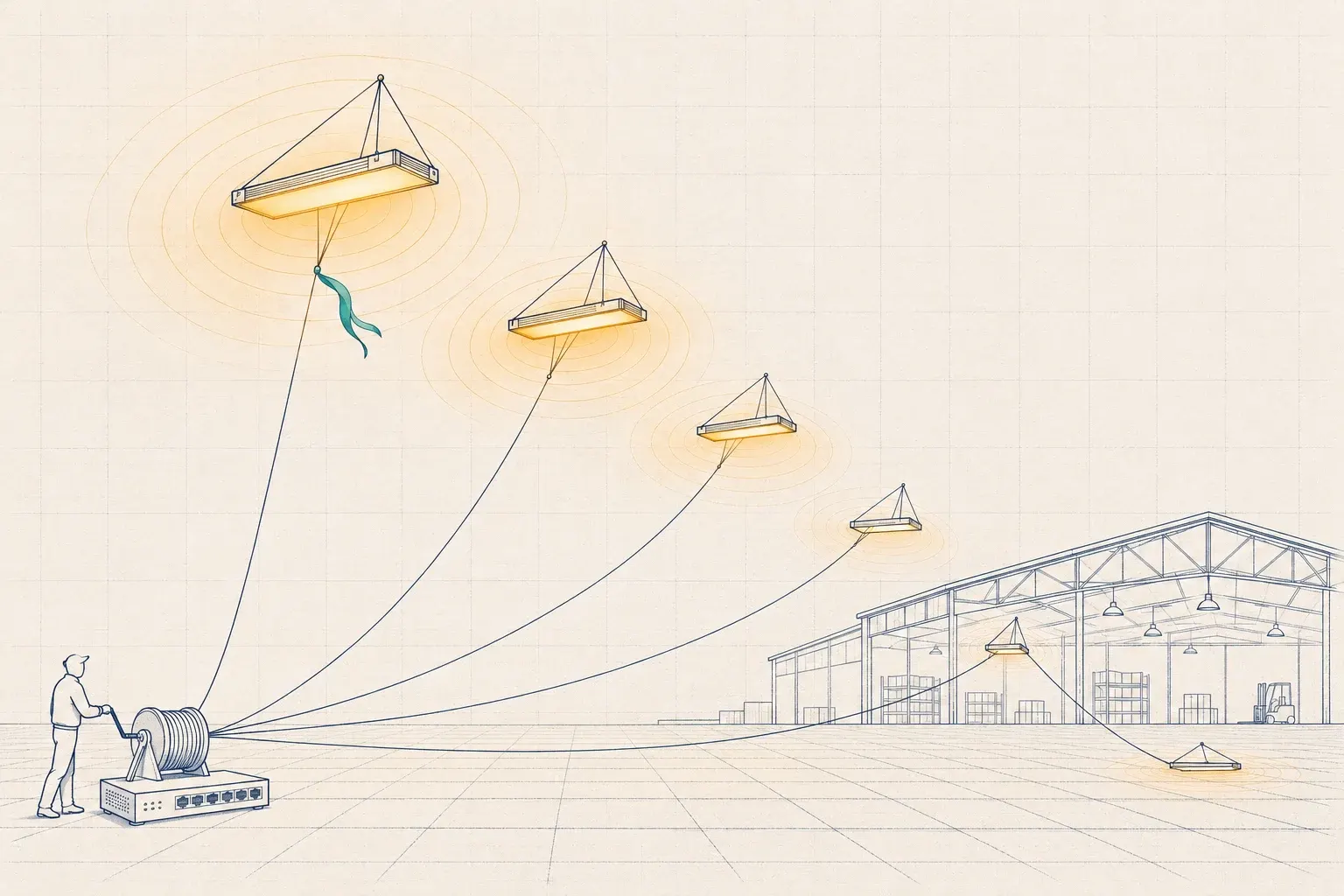
The real decision
Power over Ethernet (PoE) lighting gets pitched as the future of every ceiling. It isn’t. It is a very good fit for some buildings and a poor fit for others, and the difference comes down to geometry, wattage, and who will run the network for the next fifteen years. This post is about telling the two apart before you commit.
How PoE lighting works
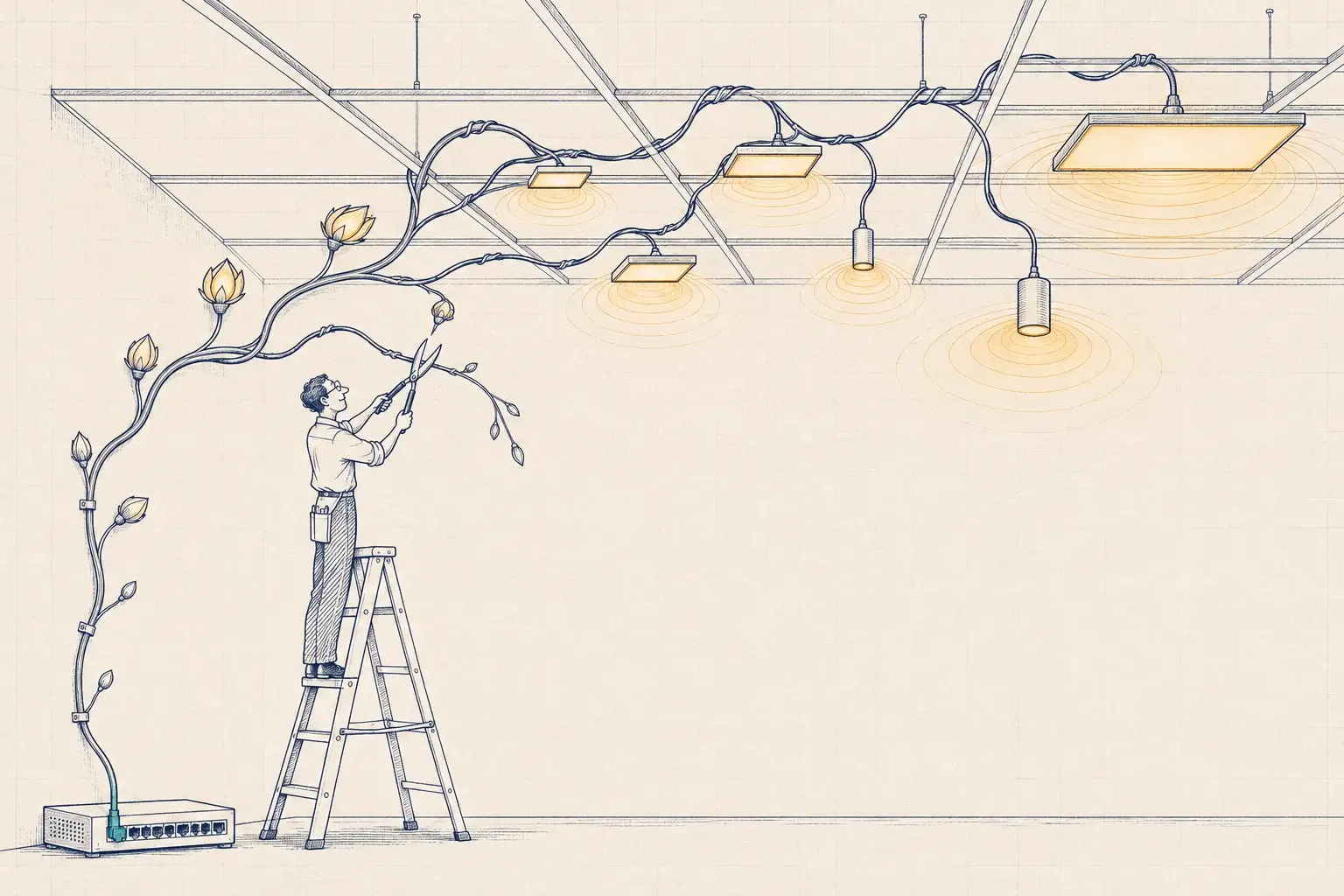
In a PoE lighting system, a network switch sends low-voltage DC power and data down the same twisted-pair cable to each fixture, or to a small node that serves a few fixtures. Sensors ride on the same network. Every device has a network identity, so to the building the lighting looks much like a set of IP phones or wireless access points.
IEEE 802.3bt, the current standard for higher-power PoE, allows up to 90 W per port at the source. Less than that reaches the fixture, because the cable turns some of it into heat. Ethernet also has a hard channel limit of 100 meters from switch to device. Those two numbers, watts per port and distance per run, shape almost every PoE decision.
What changes compared with conventional lighting:
- Line-voltage branch circuits to the fixtures go away. Line voltage now feeds switches and their backup power in the network closets.
- Low-voltage cabling can often be installed by structured-cabling contractors, subject to local code and the authority having jurisdiction (AHJ).
- Every fixture becomes a network endpoint, which brings IT’s tools, and IT’s rules.
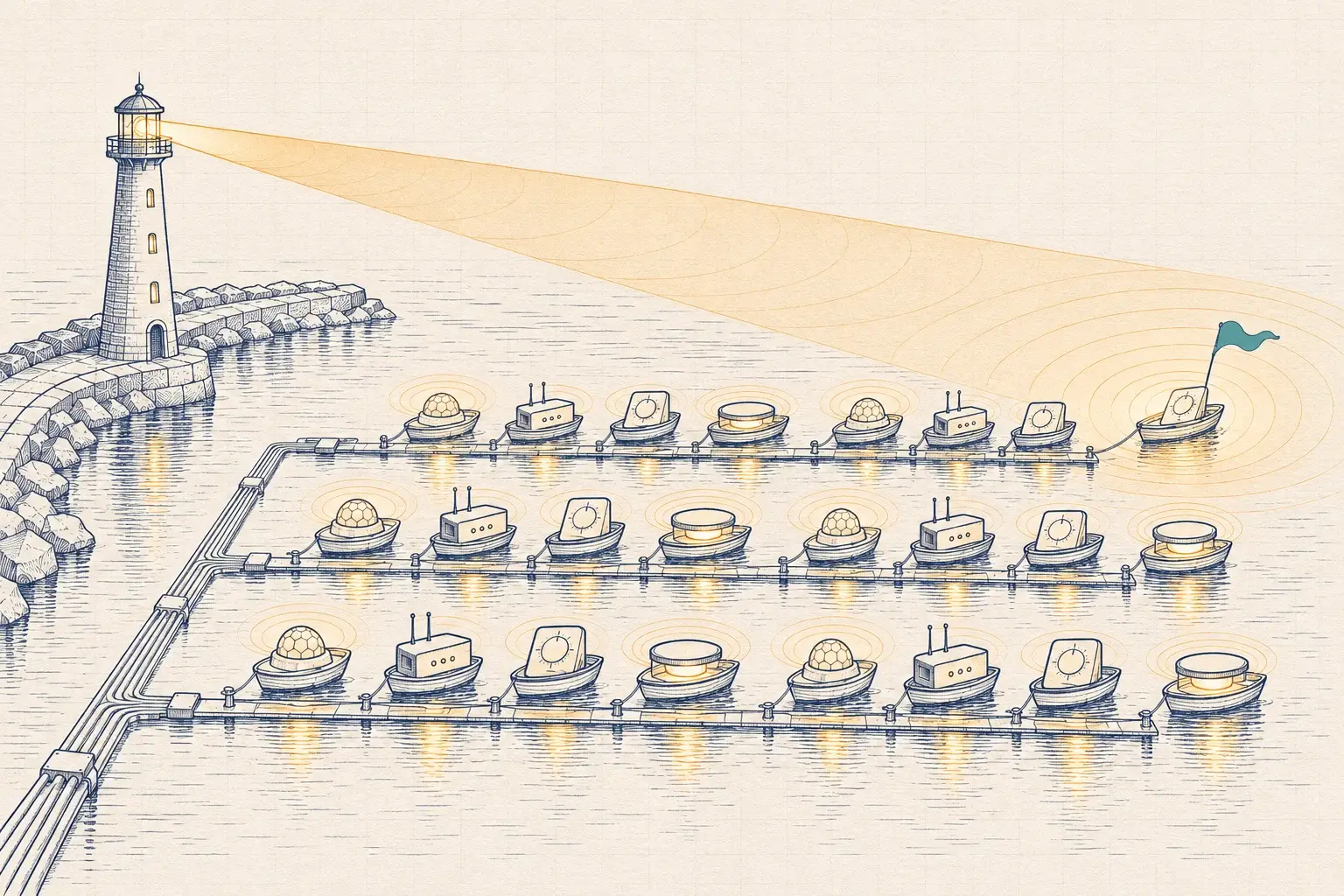
Systems differ in one important way. Some run a dedicated port to every fixture. Others run one port to a node above the ceiling that powers several fixtures. Nodes save switch ports and stretch the power budget, but each node becomes a single point of failure for the fixtures behind it, and the cable from node to fixture is often proprietary. Ask which design you are being offered, and what a replacement node costs in time and parts five years from now.
Where PoE pays off
Dense office floors with short runs. Office fixtures draw modest wattage, and most of them sit well within 100 meters of a telecom room. If the building is already pulling plenty of category cable for wireless access points and cameras, lighting runs are incremental.
Renovations where line voltage is hard. Historic downtown buildings across the region, in Tupelo, Columbus, Memphis and Huntsville, often have plaster ceilings, shallow plenums and walls nobody wants to open. Low-voltage cable routes through tight spaces more easily than conduit, and it avoids most new branch circuits.
Buildings that want data from every device. Each PoE fixture is addressable on the network and can carry sensors for occupancy, light level and sometimes temperature. If space utilization or fine-grained energy data is part of the goal, the network is already in place.
Tenant spaces that change often. Rezoning a PoE floor is a configuration change, not a wiring change. For floors re-planned with every lease, that adds up.
Owners with a strong IT partner. PoE lighting works best where the network team welcomes it, supports it, and has a seat at the design table from the first meeting.
Where it doesn’t
Warehouses. We don’t recommend PoE for warehouses with long cable runs. A distribution center floor stretches far beyond 100 meters from any closet, so you would need network closets out in the warehouse, often in unconditioned space that bakes through a Mississippi summer. High-bay fixtures also draw more power than office fixtures, which pushes against what a single port comfortably delivers once cable losses are counted. Luminaire-level wireless controls on line-voltage fixtures do the same job with far less infrastructure.
Manufacturing plants. Heat, dust, washdown, vibration and electrical noise from large motors and welders are all hard on network closets, and plants tend to have long runs and high mounting heights. A clean, compact assembly area with an office-like ceiling can be an exception. It is an exception.
Exterior lighting and parking. Poles are far apart and far from any switch. Fixture-level wireless controls and D4i sensor sockets are the better path.
Small buildings without IT staff. A bank branch or small clinic with nobody to manage switches, firmware and credentials is better served by a conventional networked lighting system with a simple, well-documented head-end.
Cold storage. The switches can’t live in the freezer, and the runs from a conditioned closet are rarely short.
A quick fit test
| Factor | Points toward PoE | Points away from PoE |
|---|---|---|
| Distance to network closet | Most fixtures well inside 100 m | Long runs, large open floors |
| Fixture wattage | Modest, office-type fixtures | High-bays and high-output fixtures |
| Ceilings and walls | Hard to run conduit; renovation | Open structure; easy to wire |
| Data goals | Utilization and fixture-level data wanted | On, off and dim is enough |
| IT involvement | Network team engaged and staffed | No IT staff, or IT unwilling |
| Layout churn | Frequent re-planning | Stable layout |
| Environment | Conditioned and clean | Hot, dusty, wet or frozen |
If most of your answers land in the middle column, PoE deserves a serious look. If most land on the right, put the budget into fixtures and wireless controls instead.
The costs people forget
Standby power. Switches draw power around the clock, whether the lights are on or not. A GSA trial of PoE lighting found lower installation cost but higher standby power. Count the switches’ own consumption, and the closet cooling it requires, in any energy estimate.
Backup power. If a switch loses power, the lights it feeds go dark. Decide early whether switches sit on a UPS, how long it lasts, and how egress and emergency lighting are handled. Emergency lighting needs a listed solution and AHJ review, and it is the first thing we resolve on any PoE design.
Lifecycle mismatch. A good fixture can outlast several generations of network switches. Plan who pays for and manages switch replacement over the lighting’s life, and confirm that future switches will still power today’s fixtures.
Cable heat. Bundles of cable carrying high power warm up, which limits how many cables can share a pathway. The cabling design has to account for it.
Ownership. When a row of fixtures goes dark at 2 a.m., does facilities call IT, or does IT call facilities? Write the answer down before move-in.
Security: the lights are now on the network
Every PoE fixture is a network endpoint. That’s useful, and it’s an attack surface. IT departments increasingly review building networks before anything connects, and they are right to. At a minimum, plan for a separate VLAN or separate switches for lighting, management access limited to named accounts, firmware updates on a schedule, and logs that someone actually reads. Our cybersecurity work covers the review your IT team will ask for.
A representative scenario: a 1920s downtown office
Consider a representative three-story office building from the 1920s in a North Mississippi downtown: plaster ceilings, a shallow plenum, one small telecom room per floor, and an owner who wants occupancy data to decide how much space to keep. The floors are compact, so nearly every fixture is a short run from the closet, and opening walls for conduit would be slow and disruptive.
That building is a good PoE candidate. We would pilot one floor first, measure switch standby consumption and fixture performance, settle emergency lighting with the AHJ, and agree on network ownership with the owner’s IT provider before committing the other floors. Our offices and bank branches page describes the sequences such a floor would use.
Now picture the same owner’s warehouse on the edge of town. We would not use PoE there.
What we’d do
- Run the fit test honestly. Geometry and wattage first, then data goals and IT appetite.
- Bench before buying. Our Lab tests the proposed fixtures, switches and sensors together, including power at the fixture and switch standby draw, before anything is ordered.
- Pilot one floor or zone. Measure it, then decide on the rest of the building.
- Get IT to sign the design. VLANs, switch management, firmware policy and on-call responsibilities, agreed in writing.
- Design for failure. Backup power, emergency lighting and switch redundancy, settled before the first cable is pulled.
- Mix where it makes sense. PoE in the offices and conventional networked controls in the warehouse is a perfectly good answer.
Where to start
If you are considering PoE for a renovation or a new office floor, our PoE and DC lighting service starts with exactly this fit review and a bench test, and ends with a pilot you can measure before you commit the whole building.
Filed under: PoE lighting · IEEE 802.3bt · DC lighting · IT/OT convergence