Representative scenario · Education
Seven-campus school district: re-commissioning what's in the ceiling
Most school districts already own the controls an energy code asks for. This scenario shows how we'd find out what still works, fix what doesn't in one summer, and write a standard so it stays fixed.
Representative scenario. A composite of the buildings we see most often, not a client case study. Results are design-stage projections, not measured outcomes.
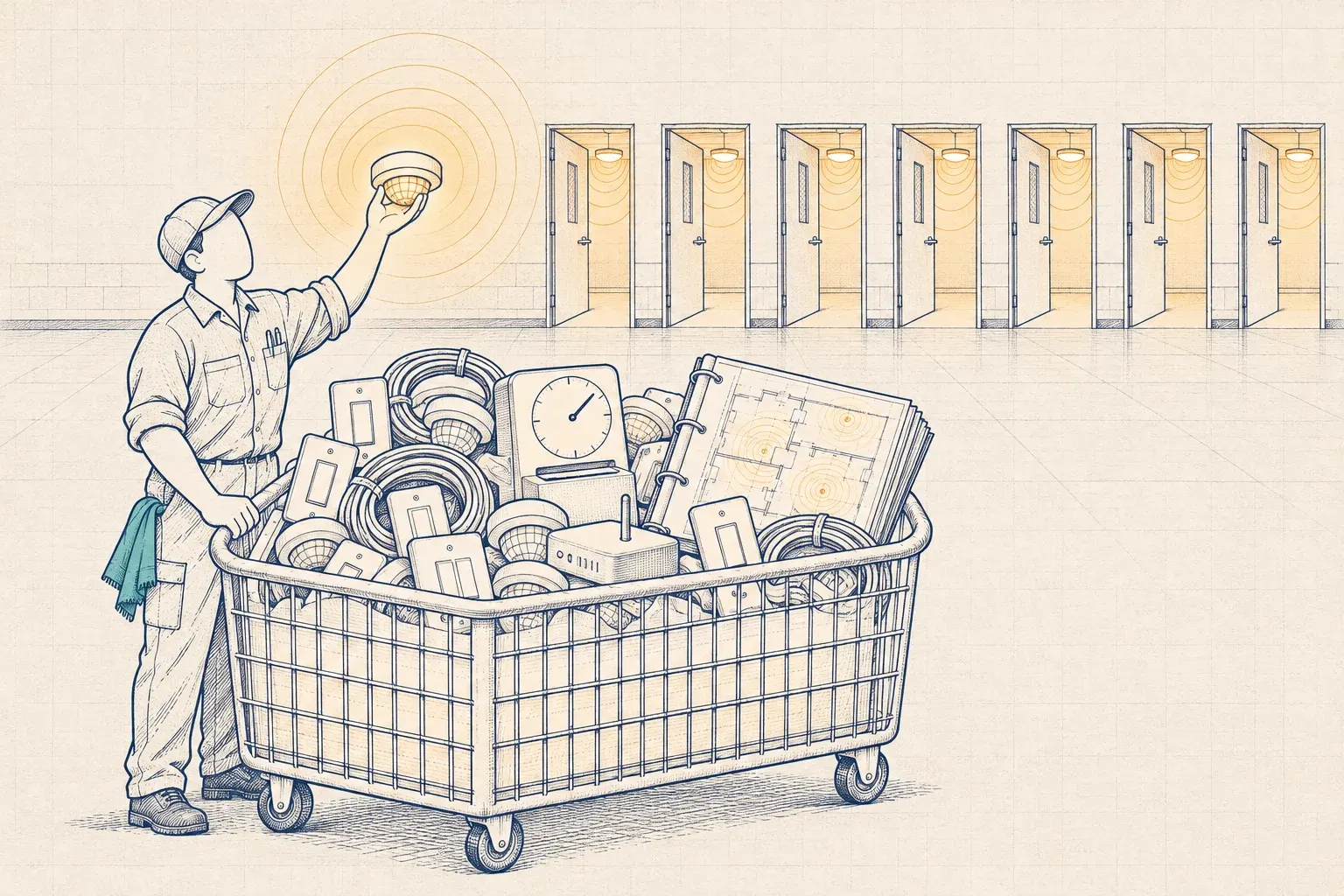
The building
- Sector
- K-12 public education
- Size
- Seven campuses, about 720,000 sq ft
- Region
- North Mississippi
- Scope
- Spring sample testing, re-commissioning of existing controls from three manufacturers, a District Controls Standard, staff training and monitoring
- Timeline
- Sample test and standard in spring, about nine weeks of summer field work, and a retest in the fall
- Industry
- Education
What we'd expect
Illustrative projections based on typical operating hours and published program averages. Every real building gets its own baseline measurement.
Sequences by space type, and what we'd expect to find
One sequence per space type, applied on every campus whatever the brand. The right-hand column is what we'd expect the spring sample test to turn up.
| Space type | Intended sequence | Failure we'd expect |
|---|---|---|
| Classrooms | Vacancy (manual on) to 50%, raise on demand, off after 20 min; window row dims with daylight | Sensors blocked by shelving or switched to auto-on; daylight zone disabled |
| Gymnasiums | Occupancy at two levels, daylight dimming under clerestories, event mode with a timeout | Event mode left on permanently; daylight disabled after a flicker complaint |
| Cafeterias | Schedule tied to meal periods, plus occupancy | Schedule still set to old bell times |
| Corridors | Schedule plus occupancy, partial-off to 50% when vacant | No holiday calendar, so corridors run at full output on days off |
| Offices and workrooms | Vacancy, off after 15 min | Mostly working; a few sensors removed during painting |
| Exterior and parking | Astronomical time clock, reduced level after the building closes | Clock an hour off, or reset after an outage |
The summer schedule
About nine weeks between the last day of school and teacher in-service.
Weeks 1–2: high school
The largest campus and the networked platform. Recover the database, load the district holiday calendar, test every sequence, and back up the configuration before anything else changes.
Weeks 3–4: middle schools
Re-commission the campus on the supported platform. Stabilize the orphaned platform at the other, test what can be tested, and document it for migration.
Weeks 5–7: elementary schools
Four smaller campuses with similar room types and the most repetitive work. Two crews work in parallel.
Week 8: summer-program wings and exterior
Test the wings that hosted summer programs once they empty, then every exterior clock and photocell, at night.
Week 9: retest and hand over
Close the punch list, retest failed items, and deliver configuration reports, test logs and the District Controls Standard before teachers return.
The buildings
This is a representative scenario built from the kind of district we see across North Mississippi. The numbers are design-stage projections, not measured results.
The district has seven campuses: four elementary schools, two middle schools and a high school, about 720,000 sq ft in total. Over a decade of renovations it collected lighting controls from three manufacturers: wired room controllers with occupancy sensors in most classrooms, a networked system at the high school, daylight sensors in gyms and cafeterias, and astronomical time clocks for the exterior. One middle school’s platform is no longer sold or supported.
On paper, the district already has the controls a modern energy code asks for. In practice, gym lights burn all weekend, classroom sensors are taped over, daylight dimming is disabled in two cafeterias, and the exterior clocks never caught up with daylight saving time. Lighting uses about 1,500 MWh a year.
Constraints
- The work window is summer. Buildings are emptier in June and July, but custodial crews strip and wax floors, and two campuses host summer programs.
- Three platforms, three tools, few passwords. Software versions, licenses and admin credentials are scattered or lost.
- A small maintenance team that covers everything from boilers to bleachers.
- Little capital budget. The plan has to work with the hardware already in the ceilings and replace only what is actually broken.
What we’d do, by phase
Survey (spring). Before summer, we’d run a one-day sample functional test at one middle school: three rooms of each space type, a gym, a cafeteria and the exterior. That day tells us how big the problem is and what kinds of failure to expect everywhere else. We’d also collect drawings, gather the system software, and talk to custodians and a few teachers.
Bench (spring). Bring a controller from each platform into the Lytbit Lab, confirm software and firmware versions, and recover or rebuild the configurations. The orphaned platform gets stabilized this summer and a replacement plan through our legacy migration service, rather than a full re-commissioning it won’t outlive.
Design (spring). Write the District Controls Standard: one sequence of operations per space type, applied to all seven campuses regardless of brand, plus naming conventions, test scripts, and the deliverables every future renovation must hand over. It is the most durable thing this project produces.
Oversee and commission (summer). Functional testing of every space against the standard, on the schedule above. District electricians handle replacements, paired with our technicians so they learn each platform’s tools as they go.
Operate (school year). The district joins our Watch support tier: remote monitoring where the platforms allow it, a quarterly report, and a sample retest each fall after furniture moves and new teachers rearrange rooms.
Projected outcome
| Measure | Current operation | Projected |
|---|---|---|
| Annual lighting energy | about 1,500 MWh | 1,130–1,280 MWh |
| After-hours lighting runtime | baseline | 40–60% lower |
| Sensors and controllers needing replacement | unknown | 5–10% |
| Campuses on one written standard | none | all seven |
Re-commissioning saves less than a new system, but it also costs far less: most of the work is settings, testing and paperwork. Re-commissioning existing controls doesn’t normally trigger the functional-testing requirement new installations face under codes such as the 2024 IECC (section C408.3). We’d test to that level anyway, so the records hold up when a future renovation does trigger it. Which edition applies at that point is something we confirm with the authority having jurisdiction.
What we’d watch out for
- Teacher complaints in August. A vacancy hold time that worked in an empty building can fail when 25 students sit still for a test. We’d set hold times with the school year in mind and retest in the first weeks.
- Overrides creeping back. Gym event modes need timeouts, or one basketball game becomes a permanent setting.
- Testing around children. Summer-program wings get tested last, after they empty.
- Clocks after storms. Exterior clocks without working backup lose time in summer outages, so we’d check astronomical settings and backup batteries on every campus.
What we’d do differently next time
We’d run the spring sample test earlier, ideally in March, so the district’s budget request reflects real failure rates rather than our estimate. And we’d train district electricians during testing, not after it. Someone who has re-aimed twenty sensors alongside a technician understands the standard better than anyone who sat through a slide deck.
Services in this scenario
Multi-brand lighting controls commissioning
Functional testing, trim and configuration reports for any brand of networked controls, so the system does what the drawings promised.
Read more
Baseline Assessment for commercial lighting and controls
A fixed-fee survey, inventory, sample functional test, bill analysis and incentive screen that ends in a prioritized roadmap. The fee is credited to the project.
Read more
Legacy lighting control system rescue and migration
For orphaned or discontinued controls: inventory, settings export, gateway bridging, and a phased migration that keeps the hardware that still works.
Read more
Managed monitoring and support plans
Watch, Tune and Steward support plans for multi-brand lighting controls, defined by scope and response time and monitored on Lytbit Ledger.
Read more
Outpatient clinic: tunable white and nurse-station scenes on BACnet
Tunable-white corridors and nurse stations, fixed high-CRI exam lighting, after-hours modes, and exam-room occupancy shared with the BMS over BACnet.
Read more
A Lighting Controls Commissioning Checklist That Prevents Callbacks
A field-ready lighting controls commissioning checklist: pre-functional checks, sensor and daylight tests, trim, schedules, integration and handover records.
Read moreGym lights on all weekend?
Tell us how many campuses you have and which platforms are in the ceilings. We'll propose a one-day sample test before you commit to a summer.