Why the dimming protocol matters more than it looks
The dimming protocol is the last few feet of a lighting control system: the conversation between a control and the driver inside each fixture. It rarely gets much attention in a specification. It should, because it decides how low the lights can dim, whether a row of fixtures looks the same at 20%, whether you can change zones without rewiring, and whether a fixture can tell you anything about itself.
Three names show up on most commercial projects: 0-10V, DALI-2 and D4i. They are not three competing brands. They are three levels of capability, and the right choice depends on the space and on what you want the fixture to do over the next ten years.
0-10V: the analog workhorse
0-10V is the default in North American commercial lighting. Two low-voltage wires, usually purple and gray, run from a control to a group of drivers. The driver supplies a small current, the control pulls the voltage down, and the driver reads that voltage as a dimming level: 10 V means full output, and at roughly 1 V or below the driver sits at its minimum. Turning the light fully off needs a separate relay or switched circuit, because 0-10V can only say “dimmer,” never “off.”
Its strengths are real. Almost every LED driver supports it, every electrician knows it, and the parts are inexpensive. In a warehouse fitted with luminaire-level controls, where the sensor and controller sit inside each fixture and talk to the driver over a few inches of wire, 0-10V is often all you need.
Its weaknesses show up at scale:
- It is one-way. The control sets a level and never hears back. A failed driver, a dead fixture or a miswired zone stays invisible until someone complains.
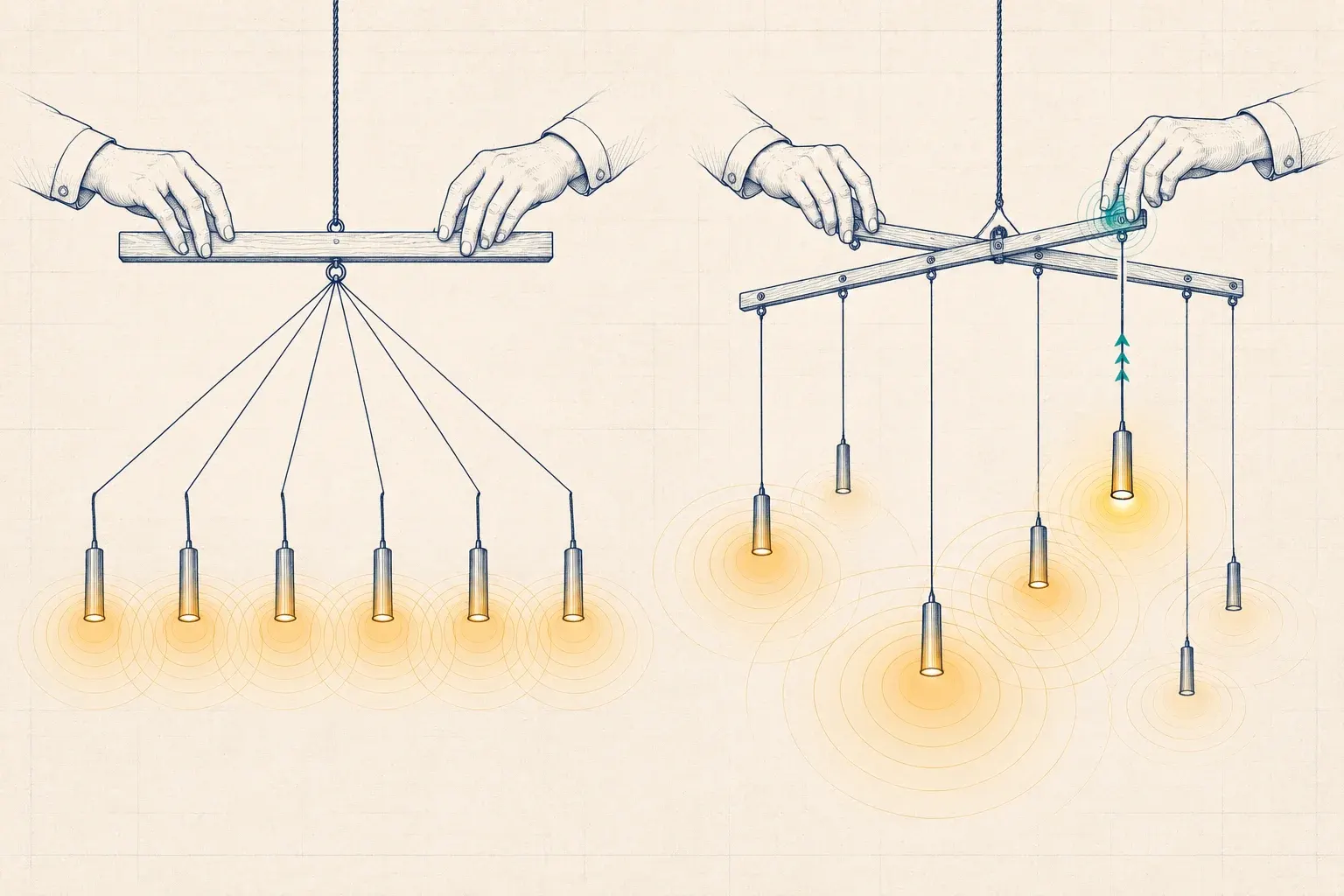
- Curves differ. Drivers from different manufacturers map voltage to light output differently, some closer to linear and some closer to logarithmic. Two fixtures on the same control pair can look noticeably different at low levels.
- Low ends differ. One driver bottoms out at 10% output, another at 1%. Put both on one zone and the dimmest setting is anyone’s guess.
- Zones are wired, not configured. Every zone needs its own control pair, so rezoning a room means pulling wire.
- Long runs drift. Voltage drop on long control runs shifts the level that the far fixtures see.
None of these is fatal. They are reasons to specify 0-10V carefully: one driver family per visible zone, a stated dimming curve, a stated minimum level, and a bench test whenever drivers are mixed.
DALI-2: digital, addressable and two-way
DALI (Digital Addressable Lighting Interface, standardized as IEC 62386) replaces the analog voltage with a digital two-wire bus. Each driver on the bus has its own address. One bus supports up to 64 drivers, which can be organized into 16 groups and 16 scenes. Because commands are addressed, zones live in software: the same wire run can become two zones or six without an electrician.
The bus is two-way. A controller can ask a driver for its current level, whether its light source has failed, and other status information. That is the difference between a system that sets light levels and a system that knows what is happening in the ceiling.
DALI-2 is the current generation, managed by the DALI Alliance, and it matters for two reasons. First, it adds standard definitions for control devices such as occupancy sensors and push buttons, not just drivers, so a sensor from one manufacturer and a driver from another can share a bus. Second, DALI-2 products go through certification testing. The original DALI earned a reputation for brand-to-brand surprises; certification exists to reduce them.
DALI-2 has limits too. The bus is slow by network standards, which is fine for lighting commands and nothing else. It needs a bus power supply with a finite current budget, and sensors draw from that budget, so you have to count devices. Cable length and wire gauge matter. And someone has to address and configure every device, which is commissioning effort that 0-10V does not require.
One practical wiring note: check the device ratings and the local code before assuming the DALI bus can share a raceway with line voltage. The answer depends on the products and the jurisdiction, and it changes installation cost noticeably.
D4i: DALI inside the luminaire
D4i is the DALI Alliance’s specification for what happens inside a luminaire. It builds on DALI-2, and according to the DALI Alliance it makes three things mandatory: power for sensors and communication modules, storage of luminaire data, and energy metering.
In practice, a D4i driver can:
- power a sensor or wireless node mounted on the fixture, with no separate power supply;
- store information about the luminaire itself, such as manufacturer, model and production details;
- report energy use and diagnostic data, such as operating hours and fault conditions.
Pair D4i with a Zhaga-D4i receptacle on the luminaire and you get a standard socket where a sensor or communication node plugs in. That is quietly one of the most useful developments in commercial lighting: the controls can be upgraded or swapped later without replacing the fixture. On exterior poles, parking lots and high-bays, where reaching the fixture is the expensive part, that matters a great deal.
D4i energy reporting also lines up with where incentive programs are heading. DLC’s networked lighting controls requirements call for energy monitoring in indoor systems that are not room-based, and fixture-level energy data is the cleanest way to provide it.
Side by side
| 0-10V | DALI-2 | D4i | |
|---|---|---|---|
| Signal | Analog voltage | Digital bus | Digital bus, inside the luminaire |
| Direction | One-way | Two-way | Two-way |
| Addressing | Per wired zone | Per driver, up to 64 per bus | Per driver, plus luminaire data |
| Feedback | None | Level and status | Level, status, energy and diagnostics |
| Rezoning | Rewire | Reconfigure | Reconfigure |
| Sensor power | Separate | Usually separate | Provided by the driver |
| Interoperability check | Bench-test curves and low ends | DALI-2 certification | D4i certification |
| Best for | Simple zones, LLLC fixtures | Rooms that change, scenes, tunable white | Exterior, high-bays, fixtures you will upgrade later |
| Watch out for | Mixed drivers in one zone | Bus power budget, addressing effort | Making sure something above actually reads the data |
How it plays out by building type
Here is how the choice tends to land in the kinds of buildings common across the Mid-South.
Warehouses and plants. With luminaire-level controls, 0-10V inside each fixture is usually fine. If you want fixture-level energy and fault data that doesn’t depend on one controls vendor, specify D4i drivers with Zhaga-D4i sockets.
Clinics and healthcare. DALI-2 earns its keep. Exam rooms, procedure rooms and nurse stations need dependable scenes, and tunable-white fixtures are easier to control consistently over a digital bus. Status feedback helps the facilities team find a failed driver before a clinician does. Our healthcare page covers sequences space by space.
Schools. Good 0-10V, specified carefully, is often the right value. Classrooms need a few predictable scenes, not addressable control of every fixture. Where a district wants fixture-level diagnostics across many campuses, DALI-2 or D4i makes maintenance easier.
Offices. Open offices that are re-planned often benefit from DALI-2 addressing. Private offices rarely need more than one dimmable zone.
Exterior and parking. D4i with a Zhaga-D4i socket is our default for new poles. It lets you start with a simple sensor and move to a networked node later without a new fixture and another bucket-truck day.
What we see on the bench
Our Lab keeps 0-10V, DALI-2 and D4i drivers from several manufacturers on the bench, and a few lessons repeat:
- Mixing 0-10V drivers on one zone produces visible differences at low levels more often than people expect. We test any proposed mix before it goes into a ceiling.
- DALI-2 bus power runs out sooner than device counts suggest once sensors and buttons join the bus. Budget it explicitly.
- Fixture energy reporting is only useful if the system above it reads and stores the data. We compare reported energy against a reference meter before anyone relies on it for measurement and verification.
What we’d do
Our default approach when we write a specification:
- Choose by space, not by building. Use DALI-2 where rooms change or scenes matter, and careful 0-10V where they don’t.
- Specify D4i drivers on new fixtures wherever the premium is modest, even if the first controls are simple. The data and the socket are the cheapest future-proofing in the ceiling.
- Lock down the 0-10V details. One driver family per visible zone, a stated dimming curve and minimum level, and a separate means of switching off.
- Require certification. DALI-2 and D4i products should be certified, and the submittal should show it.
- Bench-test the mix. Any driver and control combination we have not tested together goes on the bench first.
Our Protocol Explorer compares these with the other control protocols we work with, side by side.
Where to start
If you are writing a specification or reviewing a submittal and the dimming protocol is a line nobody has questioned, our controls design service will set it per space type and write the details that prevent low-end surprises. For questions about a specific driver and control combination, write to the Lab at lab@lytbit.com.
Filed under: DALI-2 · 0-10V · D4i · LED drivers · dimming